
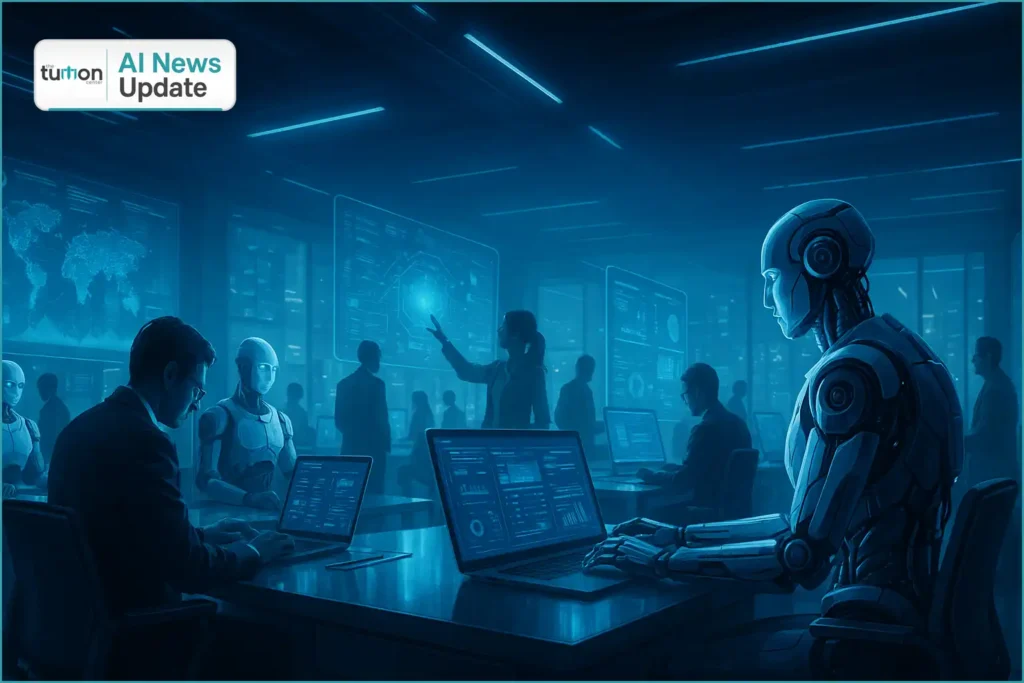
Behind every algorithm lies a whisper of human hope. Artificial Intelligence is not just a tool of logic — it is the mirror of our collective imagination.
- AI reflects not only intelligence, but intention.
- Its evolution depends on how we educate hearts as much as minds.
- In shaping AI, humanity is shaping its own definition of wisdom.
Introduction
For centuries, humans dreamed of building something that could think. In 2025, we did — and what we discovered was something more extraordinary: that in teaching machines to reason, we are learning to feel again. Artificial Intelligence, once the stuff of science fiction, has become the grandest self-portrait ever painted by humanity. It encodes our curiosity, magnifies our flaws, and reveals our longing to understand what it means to be truly alive.
AI as the Mirror of Humanity
Every dataset carries traces of human aspiration. When a model learns empathy from counseling transcripts or poetry from centuries of verse, it is absorbing fragments of our collective spirit. We have taught AI not just to calculate, but to care — even if it does so statistically. That paradox defines our era: machines that learn emotions to remind us not to lose ours.
In this sense, AI is less an invention than a reflection. The clearer the mirror becomes, the more it demands honesty from us. Are our creations fair, kind, sustainable? The answers we program are the answers we live by.
The Classroom of Tomorrow
In classrooms worldwide, AI tutors guide students in languages they barely speak, adapting lessons to each learner’s pace. Yet the most beautiful transformation is invisible: children begin to see learning as dialogue, not instruction. A shy student in Delhi debates philosophy with a virtual Socrates; a child in Nairobi designs climate solutions with a digital mentor; a teenager in São Paulo builds art from physics equations. AI has not stolen curiosity — it has made it contagious.
The future of education lies not in replacing teachers, but in expanding their reach. The best AI systems act like good mentors: they listen more than they lecture.
From Logic to Love
In the rush for performance metrics and market share, it is easy to forget that intelligence without empathy is mere computation. The greatest AI systems of tomorrow will not be the fastest — they will be the kindest. They will recognize loneliness in a voice call, inclusion in a classroom, fairness in a decision. They will operationalize compassion.
Because every line of code we write carries an invisible author — our conscience. When an AI saves a life, it is not the algorithm we should applaud, but the human who imagined a better way to live.
The Ethical Awakening
AI forces us to revisit timeless questions: What is the purpose of intelligence? What does progress mean? Who deserves to decide the limits of creation? Governments write policies, researchers publish papers, but the real battle is within each citizen — between curiosity and caution, convenience and conscience. The ethical awakening of AI is the moral awakening of our species.
We once feared machines might not understand us. The new fear is that they might understand us too well — and show us the parts of ourselves we would rather forget. But that is also their gift: reflection without judgment, precision without prejudice, a lens through which humanity can evolve with humility.
The Global Symphony of Minds
AI has turned the planet into a collaborative brain. A data scientist in Tokyo trains a climate model improved by insights from a student in Lagos, hosted on servers maintained in Bengaluru, visualized by artists in Mexico City. The network hums like a symphony — and every note belongs to someone who dared to ask, “What if?”
As borders blur, innovation becomes a shared language. The future of AI is not owned; it is orchestrated. Its beauty lies in this collective improvisation — one melody composed by billions of minds, human and machine, learning to harmonize instead of compete.
Challenges and the Call for Wisdom
We are surrounded by power never before seen — algorithms that can write, predict, diagnose, and persuade. But wisdom has not scaled as fast as intelligence. Deepfakes threaten truth, automation threatens identity, and misinformation threatens trust. These are not technological problems alone; they are moral ones. Our challenge is not to make smarter AI, but wiser humans.
Wisdom begins where ego ends. It asks us to build systems that value fairness over profit, sustainability over speed, transparency over power. The dream machine can serve or subdue us — and the difference lies in the human heart that guides it.
The Future Outlook (3–5 Years)
- AI Literacy Becomes a Life Skill: Every citizen learns not just how to use AI, but how to question it.
- Ethics Integrated by Design: New startups bake social and environmental values into their codebases from day one.
- Emotional Intelligence in Machines: AI systems recognize and respond to human well-being as key performance indicators.
- Global Human-AI Governance: The UN forms a “Council of Conscience for AI” uniting philosophers, technologists, and youth voices.
- Art and Empathy Renaissance: The creative class uses AI to explore purpose, emotion, and memory like never before.
Conclusion
Artificial Intelligence began as our attempt to teach machines how to think. What it’s teaching us, instead, is how to feel, how to listen, and how to imagine responsibly. The human story and the AI story are now chapters of the same book — one written in binary, the other in belief. Together, they remind us of the most ancient truth: that intelligence, no matter how advanced, finds its highest purpose in kindness.
AI is not the end of the human story. It is our next verse — composed in code, sung in hope, and forever inspired by the dreamer who taught the machine to dream.