
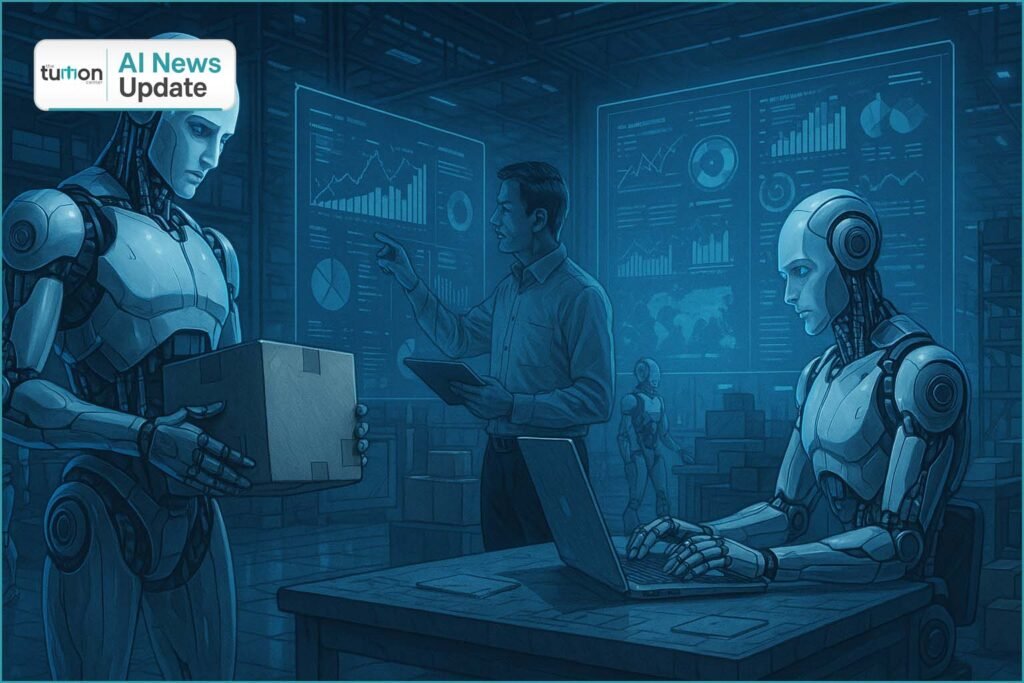
The process intelligence leader redefines enterprise automation with AI agents that see, think, and act — bringing digital twins to life across global supply chains.
- Event held November 7 2025, Munich – attended by 12 000 global participants. ([Celonis Newsroom](https://www.celonis.com/newsroom))
- AI Agents analyze live workflows, identify inefficiencies, and auto-trigger process improvements without human intervention.
- Digital twins simulate business operations across finance, supply chain, and production, making enterprise systems “self-healing.”
Introduction
The next evolution of enterprise automation has arrived. Celonis, the pioneer of process mining, has unveiled a breakthrough at its annual Celosphere conference: a suite of AI agents and digital-twin technologies that make business operations intelligent, autonomous, and transparent. In the words of Celonis Co-CEO Alex Rinke, “We’ve moved from process visibility to process vitality.”
For learners and professionals, this shift marks a defining moment in digital transformation. The tools businesses use to manage workflows are now becoming cognitive — capable of understanding context, predicting outcomes, and taking corrective actions. In essence, the “nervous system” of the enterprise just became self-aware.
“`
Key Developments
At Celosphere 2025 in Munich, Celonis introduced three major innovations:
- AI Process Agents: These are autonomous assistants that monitor, diagnose, and optimize workflows using Celonis Process Intelligence Graph. They can balance cash flow, reroute logistics, or trigger vendor updates in real time — powered by GPT-5-tier reasoning models fine-tuned for enterprise data.
- Enterprise Digital-Twin Platform: A real-time simulation environment that mirrors every transaction, event, and resource flow in an organization. It helps decision-makers test scenarios (“What if raw material costs rise 15 %?”) and visualize consequences instantly.
- Celonis Studio: A no-code interface where business users can build their own AI automations and custom dashboards using natural language commands.
Celonis claims that these systems have already reduced process inefficiencies by up to 30 % in pilot projects with clients like Siemens, Johnson & Johnson, and Lufthansa Cargo.
Impact on Industries and Society
The implications extend beyond corporate efficiency. Imagine factories that anticipate supply bottlenecks before they happen, hospitals that optimize bed allocation dynamically, and universities that simulate enrollment flows for resource planning. Digital twins turn static organizations into living systems — continuously learning from their own data.
For society, this marks a leap toward “transparent automation.” Instead of black-box algorithms, Celonis visualizes how AI decisions affect operations, giving humans control and insight. For students, it’s a new frontier in interdisciplinary learning: combining AI reasoning, data visualization, and systems thinking.
Expert Insights
“Process intelligence is no longer just analytics — it’s action,” said Alex Rinke. “We’re giving organizations the ability to sense and respond like living organisms.”
Industry analyst Sarah Burnett from Everest Group added: “Digital twins will become the sandbox for ethical AI deployment. They allow testing consequences before real-world rollout.”
Prof. Ananya Mehta from IIM Bangalore observed that such innovations will redefine management education. “Students will soon learn business strategy inside simulated enterprises powered by AI twins. That’s experiential learning at a whole new level.”
India & Global Angle
India is playing a central role in Celonis’s expansion. With delivery centers in Pune, Gurugram, and Bengaluru, the company is training over 50 000 process analysts and automation engineers in partnership with TCS and Infosys. IIT Delhi has launched a joint lab on Process Mining and Intelligent Automation with Celonis to create curriculum modules for AI-driven management.
Globally, manufacturing hubs in Germany, Japan, and the U.S. are adopting Celonis digital twins to ensure supply-chain resilience amid economic uncertainty. Airlines and logistics companies are using AI agents for predictive scheduling, minimizing delays and costs.
Policy, Research and Education
Governments and universities are starting to explore “AI process literacy” as part of future workforce training. The OECD and World Economic Forum have highlighted digital twins as essential for sustainable and ethical industrial transformation. Educational programs in business analytics are incorporating Celonis tools for real-world simulations.
Celonis has also announced its “AI Academy for Operations” — a global learning initiative to train students and professionals in process intelligence, automation ethics, and digital-twin design. Free online courses and certification tracks are being made available through edX and Coursera in 2026.
Challenges & Ethical Concerns
As systems grow more autonomous, ethical and operational challenges emerge. If AI agents make workflow decisions, who is accountable when outcomes go wrong? Celonis is tackling this through “explainable process AI,” which records every AI decision in a transparent audit trail. Still, enterprises must develop new policies for shared accountability between humans and machines.
Another concern is workforce displacement. While automation can remove repetitive tasks, it also demands upskilling. Celonis emphasizes “augmentation, not replacement,” and is funding retraining initiatives for employees transitioning into analytics and oversight roles.
Future Outlook (3–5 Years)
- AI Agents will become standard features in enterprise software, working as co-pilots for every department.
- Digital twins will evolve into “sentient dashboards,” offering predictive narratives rather than static reports.
- Management students will train on live enterprise simulators using real process data and AI advisors.
- Governments will adopt process intelligence to optimize resource distribution and policy effectiveness.
- Enterprises will build ethical automation teams to ensure transparency and fairness in AI-driven operations.
Conclusion
Celonis’s breakthroughs at Celosphere 2025 mark the dawn of the autonomous enterprise — where AI agents and digital twins bring intelligence to every process, person, and policy. For learners and leaders, the message is clear: understanding process intelligence isn’t optional anymore; it’s the new literacy of business transformation. As industries evolve toward self-healing systems, the most valuable skill will be the ability to collaborate — not compete — with intelligent operations.