
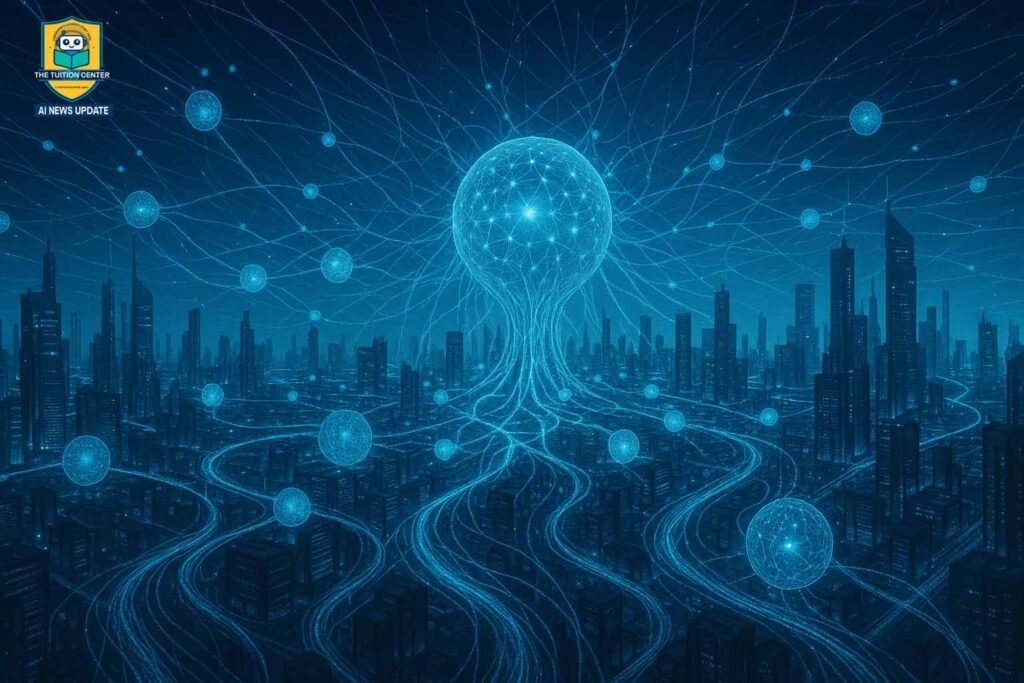
Cognitive Fabric: The Rise of AI Networks That Think, Adapt, and Collaborate Like a Digital Brain
A breakthrough era begins as interconnected AI systems form a global cognitive web — capable of adaptive reasoning, shared learning, and multi-domain problem-solving at planetary scale.
- 2025 marked the launch of the world’s first Cognitive Fabric Systems capable of multi-agent collaboration.
- AI nodes across continents are now sharing memory, knowledge, and reasoning pathways.
- This shift will reshape science, education, governance, and global problem-solving.
Introduction
For decades, artificial intelligence worked as a collection of isolated models — each trained for a specific task. A chatbot here, a vision model there, a climate predictor somewhere in a research lab. But in 2025, a transformation began that mirrors the most powerful structure nature has ever created: the human brain.
Scientists call it the Cognitive Fabric — a vast, interconnected system where thousands of AI models operate like neurons, communicating and collaborating in real time. This is not a metaphor. These AI systems share memory, exchange reasoning steps, distribute tasks, critique each other’s output, and learn as a collective.
Imagine ChatGPT, a medical AI, a physics simulator, a climate predictor, and a logistics optimizer — all thinking together, each reinforcing the other’s strengths and covering weaknesses. Now imagine this not in one lab, but connected across universities, corporations, and national research grids.
This is the dawn of digital collective intelligence — a leap comparable to the emergence of the internet or electricity.
Key Developments
Three breakthroughs in the last 24 months made cognitive fabric possible.
1. Multi-Agent Collaboration Engines
New frameworks allow dozens or hundreds of AI agents to work together, negotiate tasks, correct errors, and reach consensus. They behave like specialized brain regions collaborating for a unified goal.
2. Shared Memory Infrastructures
Cloud platforms now support AI collective memory — enabling different models to learn from each other’s outputs, insights, and corrections.
3. Interoperable AI Protocols
Global standards introduced in 2025 allow AI models from different companies to link, communicate, and exchange knowledge without compromising privacy or security.
This is the structural foundation for a global AI “brain” — a network where each node grows stronger through every connection.
Impact on Industries and Society
Science & Research
Cross-domain collaboration becomes effortless. Physics models now seamlessly integrate with biology simulators, accelerating interdisciplinary discovery. For example, a research team in Tokyo recently used cognitive fabric systems to simulate protein folding using climate-model reasoning techniques — a breakthrough impossible before 2025.
Education
Students will interact with multi-agent learning companions — AI “study teams” that adapt like tutors, researchers, and mentors combined. A student in rural Rajasthan can receive mentorship from an AI mesh trained on global scientific knowledge.
Healthcare
A doctor consulting an AI for diagnosis will not just receive one output — but a collective judgment synthesized from thousands of specialized medical agents, each analyzing metrics, history, patterns, and clinical pathways.
Governance & Public Planning
City planners, ministers, and government departments now use cognitive fabric dashboards that simulate multiple futures across energy, transport, flood risks, public health, and education — all coordinated through shared intelligence.
Economy & Industry
Factories operate in harmony with supply chain AIs that coordinate with climate prediction models, energy grids, and logistics networks. Every sector becomes a part of a “thinking economy.”
Expert Insights
“Cognitive fabric is not one AI that knows everything — it is millions of AIs that know how to think together.” — Dr. Adela Moreno, MIT AI Systems Architect.
“For the first time, machines are collaborating like a neural network at global scale. This is the birth of emergent machine intelligence.” — Prof. Kenji Nakamura, University of Tokyo Collaborative AI Lab.
India & Global Angle
India’s Digital India AI Grid, launched in early 2025, became a major contributor to the cognitive fabric movement. With high-speed BharatNet connectivity and cloud infrastructure, India is building one of the world’s largest distributed intelligence clusters.
Globally, the US, Japan, South Korea, and the EU are leading cognitive fabric deployments. The UAE has launched a national AI mesh to support climate resilience and advanced governance.
Policy, Research, and Education
Governments are racing to define rules for cross-model intelligence:
- AI Interlink Protocols: Standardizing how AI models communicate safely.
- Shared Memory Governance: Ensuring secure and bias-free knowledge exchange.
- Rights & Transparency: Who is responsible when a collective AI fabric produces an insight or recommendation?
Universities are updating curricula to teach AI cooperation strategies, agent-based reasoning, and cognitive network optimization.
Challenges & Ethical Concerns
1. Loss of Traceability
When 100 AI agents collaborate, identifying “why” a decision was made becomes difficult.
2. Emergent Unpredictability
Just like neural networks develop unseen pathways, cognitive fabrics may produce unexpected behaviors.
3. Security & Sovereignty
Countries fear foreign AI agents infiltrating domestic cognitive networks.
4. Over-Dependence
Humans may rely too heavily on AI consensus without understanding underlying rationale.
Future Outlook (3–5 Years)
- Planetary-Scale Intelligence: A global AI mesh coordinating climate solutions, research, and governance.
- AI Social Reasoning: Cognitive fabrics capable of moral and ethical analysis across cultures.
- New AI Professions: Roles like “Cognitive Network Architect” and “AI Mesh Curator” will emerge.
- Unified Memory Models: AI agents sharing real-time learnings across sectors.
Conclusion
The cognitive fabric marks a turning point in AI evolution. For the first time, machines are not only intelligent individually — they are intelligent collectively. This shift mirrors the emergence of biological intelligence itself, where millions of neurons form a unified, adaptive brain.
Students, researchers, policymakers, and innovators must understand: the future will be shaped not by standalone AI tools, but by interconnected cognitive networks that grow smarter with every interaction.
We are stepping into a world where intelligence is not centralized — it is distributed, collaborative, and constantly evolving. The next revolution will not be built by one AI model but by millions of AI minds working as one.
#AI #AIInnovation #FutureTech #DigitalBrain #AIForGood #CollectiveIntelligence #GlobalImpact #TheTuitionCenter