
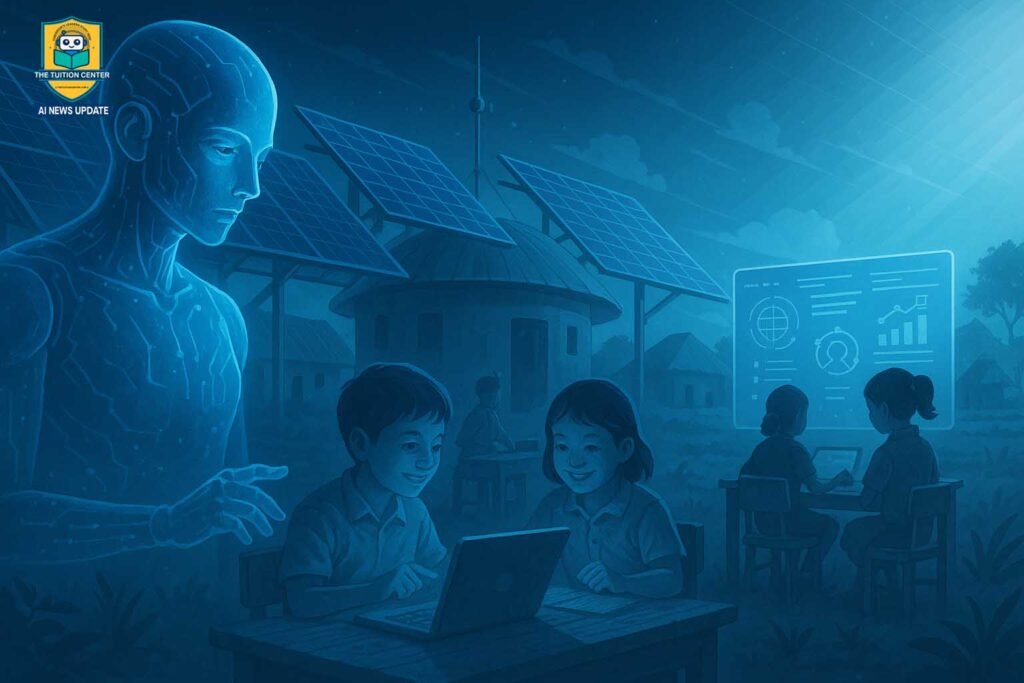
Classroom to Metaverse: Countries Roll Out National 3D Virtual School Systems for Students
From blackboards to holograms, governments are beginning to build national 3D virtual school systems where every child can walk into a shared metaverse campus — no matter where they live in the real world.
- Several countries are piloting nationwide 3D virtual school platforms for K–12 students.
- Students can attend lifelike digital campuses, interact as avatars, and perform experiments in simulated labs.
- If executed well, metaverse education could reduce geographic inequality — but it could also deepen the digital divide.
Introduction
The classroom of the 20th century was defined by chalk, wooden desks, and a blackboard at the front of the room. Even as smartboards and tablets entered schools over the last decade, the basic structure of education remained the same: students in a physical room, with a single teacher and a fixed timetable.
But in the mid-2020s, an entirely new model is emerging: the national 3D virtual school system. Instead of being bound to physical classrooms, students log into shared metaverse-style campuses where they appear as avatars, attend lectures in digital auditoriums, run experiments in simulated science labs, collaborate on group projects in virtual breakout rooms, and even go on “field trips” to historic sites, planetary surfaces, or reconstructed ancient cities — all without leaving their home, village, or local learning hub.
For governments dealing with teacher shortages, infrastructure gaps, and unequal school quality, the metaverse offers something radical: a way to give every learner access to the same rich, high-quality learning environment — regardless of whether they live in a major city or a remote hamlet. At the same time, these systems promise to blend AI tutors, real-time analytics, and immersive 3D experiences into a single continuous learning universe.
The shift from “classroom” to “metaverse campus” is not a simple technology upgrade. It represents a rethinking of what it means to attend school, to participate in a class, and even to “be present” as a student. And as more countries experiment with national metaverse learning platforms, a critical question emerges: will this become the default infrastructure of schooling by 2030?
“`
Key Developments
The concept of virtual reality in education is not new — schools have used VR headsets, gamified 3D content, and remote learning platforms for years. What is new in 2025 is the scale and ambition. We are no longer talking about “VR modules” embedded in traditional classrooms; we are talking about entire school systems built inside persistent 3D worlds.
Several trends have converged to make this possible:
- Cheaper, lighter headsets and AR glasses that allow students to engage in 3D environments for longer durations without heavy hardware.
- Cloud-rendered graphics that make high-quality 3D experiences accessible even on modest devices via streaming.
- AI-powered classroom orchestration that manages lesson flow, assessments, attendance, and personalised support inside the virtual campus.
- National digital education missions that push governments to build centralized platforms instead of fragmented apps.
- Post-pandemic familiarity with remote learning, which normalised the idea that “school” is not confined to a building.
In pilot projects around the world, students already log into these national platforms at fixed times, join their classmates as avatars, and participate in mixed sessions where a human teacher, an AI co-teacher, and 3D simulations run side by side. Instead of a chemistry lab that can only accommodate 30 students, a virtual lab can host thousands simultaneously, each running safe experiments with real-time guidance.
A typical day in a metaverse-enabled school might look like this:
- A student in a rural village wears a low-cost AR headset and “walks” into a digital campus courtyard where classmates from all over the country are gathering.
- The bell rings — not in a hallway, but as a gentle chime across the platform — and doors to the “Math Dome” open.
- Inside, a human teacher’s live video feed is projected above the room, while an AI avatar moves around the hall, spotlighting different students and visualising concepts in 3D.
- For a history class, students step into a reconstruction of an ancient city, guided by narration that ties dates and events to memorable visuals.
- At the end of the day, each learner receives an AI-generated learning summary, emotional engagement report, and recommended revision activities, all accessible from home.
This is not a distant sci-fi scenario. It is the direction in which many education systems are now experimenting, as they search for ways to modernise learning fast enough to keep pace with AI, automation, and global skill demands.
Impact on Industries and Society
The rollout of national 3D virtual school systems will send shockwaves far beyond the education sector. If done right, it could transform how students learn, how teachers teach, how industries recruit, and how societies think about opportunity.
1. Education: From passive listening to immersive doing
Traditional schools often struggle to move beyond chalk-and-talk or slide-based lectures. In a metaverse learning system, the default mode is experiential. Instead of reading about the water cycle, students walk through a 3D simulation of clouds forming, condensation, and rainfall. Instead of memorising formulas, they manipulate objects, stretch shapes, and see equations come alive in space.
This immersion has two major effects: it increases engagement and deepens understanding. Concepts that once felt abstract become concrete when students can “touch” representations, walk around them, and see cause-and-effect unfold visually.
2. Teacher role: From content delivery to high-value mentoring
In a virtual national campus, AI systems can handle routine tasks: distributing assignments, marking objective questions, tracking attendance, and even offering real-time hints to struggling students. This allows human teachers to shift into higher-value roles — facilitating discussions, guiding projects, mentoring students emotionally, and adapting pedagogy for diverse needs.
Rather than replacing teachers, the metaverse pushes them into the roles that truly need human judgment: ethics, empathy, motivation, and nuanced feedback.
3. Industry and employment: A new talent benchmark
When students across an entire country learn from a unified metaverse platform, industries gain access to a more standardised benchmark of skills. Imagine engineering students who all completed 3D simulations of bridges under stress, chemistry learners who ran hundreds of safe experiments virtually, or commerce students who ran trade simulations in global virtual markets.
Recruiters can increasingly rely on performance data from these platforms: which students consistently solved complex 3D problems? Who demonstrated resilience in adaptive challenges? Which learners collaborated effectively in simulated global teams?
Over time, this kind of verified, skill-based record could become as important as traditional report cards — or even more.
4. Rural empowerment and geographic neutrality
Perhaps the most powerful societal shift lies in access. Physical schools in remote or underserved areas often lack laboratories, specialist teachers, or advanced subjects. A national metaverse school system can give every learner the same digital physics lab, the same AI language coaches, and the same immersive experiences — even if their nearest brick-and-mortar school has only a handful of staff.
This doesn’t erase all inequality, but it changes the baseline. The gap becomes less about “which school building you are near” and more about connectivity, device access, and support — still real issues, but far easier to solve than constructing thousands of new, fully equipped campuses.
5. Family and community: New ways of participating in schooling
With learning happening in a persistent virtual environment, parents can gain new visibility into their child’s learning journey. Dashboards can show concepts mastered, areas of struggle, and emotional engagement levels over time. Community mentors, alumni, and industry professionals can “visit” virtual classrooms without needing to travel, offering talks, guidance, or project feedback to students across the country.
In many ways, the metaverse school system has the potential to turn education from a closed box into a living ecosystem — one where families, communities, and industries are all part of the environment, not just occasional visitors.
Expert Insights
As governments and EdTech companies experiment with these systems, education futurists, child psychologists, and technologists are offering a mix of enthusiasm and caution.
“Metaverse-based schooling can finally break the historic link between a child’s pin code and the quality of education they receive. But we must remember that ‘immersion’ is not the same as ‘learning’ — design choices will determine whether this becomes a distraction engine or a transformation engine,” notes one leading education strategist involved in virtual campus pilots.
“We are moving from worksheets to worlds,” says a digital pedagogy researcher. “That shift demands new literacy — teachers must learn to think in terms of experiences, not just explanations.”
Psychologists also warn about screen fatigue, identity formation in avatar-based environments, and the risk of isolation if virtual schooling isn’t balanced with offline physical activity and real-world social interactions. The consensus across fields is clear: the metaverse can be extraordinarily powerful — if coupled with strong human, ethical, and developmental frameworks.me `
India & Global Angle
India is uniquely positioned to become a global leader in metaverse-based learning because of its scale, demographic strength, and digital infrastructure. With over 260 million school students — more than the entire populations of many developed countries — India’s education system faces structural challenges: uneven teacher distribution, infrastructure gaps, and significant variation in school quality across states.
The National Digital Education Architecture (NDEAR), DIKSHA 2.0, PM eVIDYA, and IndiaAI Mission lay the groundwork for a national-level virtual learning ecosystem. Several states are already piloting 3D content modules in science and mathematics, while private EdTech players are experimenting with early versions of virtual school prototypes.
What sets India apart is the scale of ambition. With the right investments in metaverse infrastructure, India could build one of the world’s largest unified virtual school platforms, enabling:
- Standardised high-quality STEM labs accessible to every district
- AI-driven personalised tutoring in regional languages
- National-level virtual classrooms where top teachers reach millions
- 3D skill-building modules for the future workforce
Globally, countries like UAE, South Korea, Singapore, and Finland are racing ahead. The UAE’s “Virtual Learning City” aims to bring all K–12 students into a shared immersive platform. South Korea’s “Metaverse Seoul Education District” allows students to attend virtual lessons taught by digital and human co-teachers. Finland is studying the impact of 3D education on cognitive retention.
As nations adopt these systems, one thing is clear: the competition will not be about buildings, but about digital learning ecosystems. The countries that invest now will shape the next generation of globally competitive talent.
Policy, Research, and Education
The rise of national metaverse schools requires an entirely new policy framework. Traditional education laws never imagined a world where students attend school as avatars, teachers instruct from digital amphitheaters, and assessments take place inside AI-orchestrated simulations.
Key policy considerations emerging worldwide include:
- Accreditation standards for virtual classrooms and 3D labs
- Age-appropriate metaverse behavior policies
- Data protection for student interactions inside virtual spaces
- Teacher training programs in immersive pedagogy
- Equitable device and connectivity access guarantees
- AI monitoring safeguards to prevent over-surveillance
Research institutions are also shifting focus. Universities in Japan, Canada, and Germany have launched “XR Pedagogy Labs” studying how immersive environments influence memory, emotion, and problem-solving. Early results suggest that 3D simulations significantly improve long-term retention compared to traditional textbook learning — particularly in science and math.
Teacher training stands to be transformed too. Educators now require fluency in:
- 3D content design
- Digital classroom management
- Human–AI co-teaching strategies
- Avatar communication psychology
- Metaverse safety protocols
These shifts will redefine teacher preparation programs, job roles, and professional development across the world.
Challenges & Ethical Concerns
Despite its promise, the metaverse school revolution brings significant risks. Countries must approach with urgency and responsibility to avoid unintended consequences.
- Digital Divide: If devices and connectivity aren’t universal, metaverse schooling may widen inequalities instead of closing them.
- Screen Fatigue: Long hours in immersive environments could create health issues if not balanced with offline activity.
- Identity & Psychology: Avatar-based interactions can affect self-esteem, confidence, and social behavior.
- Cybersecurity: Virtual campuses must be protected from intrusion, impersonation, and harmful behavior.
- Teacher Displacement: Some fear that virtual AI classrooms could reduce human teaching roles — unless clear hybrid models are defined.
- Pedagogical Integrity: Not all 3D experiences lead to learning. Poorly designed environments may entertain more than they educate.
Governments must balance innovation with safety, inclusivity, and long-term wellbeing. The metaverse’s role in education is too powerful to leave unregulated — but also too transformative to ignore.
Future Outlook (3–5 Years)
- 3D National Boards: Countries will launch fully immersive versions of national curriculum subjects.
- Hybrid Schooling Norm: Students will attend physical school 3–4 days a week and virtual school 1–2 days.
- Global Classrooms: Students from different countries will study together inside shared virtual spaces.
- AI Co-Principals: AI systems will assist school leadership in planning, assessment, and analysis.
- Virtual Skill Districts: Specialized 3D environments for robotics, astronomy, medicine, and entrepreneurship will emerge.
- Metaverse Board Exams: Interactive assessments will replace rote memory-based exams.
Conclusion
The transition from classroom to metaverse campus is one of the most profound shifts in modern education. It breaks the physical barriers that have limited learning for generations and opens the door to equal access, immersive understanding, and national-scale transformation.
But the metaverse cannot solve every problem on its own. It must be paired with thoughtful policy, teacher empowerment, offline balance, and strong digital ethics. If nations get it right, this could become the most important educational infrastructure of the 21st century — a shared virtual world where every child, regardless of background, can learn not just from books, but from immersive experiences that ignite curiosity and shape futures.