
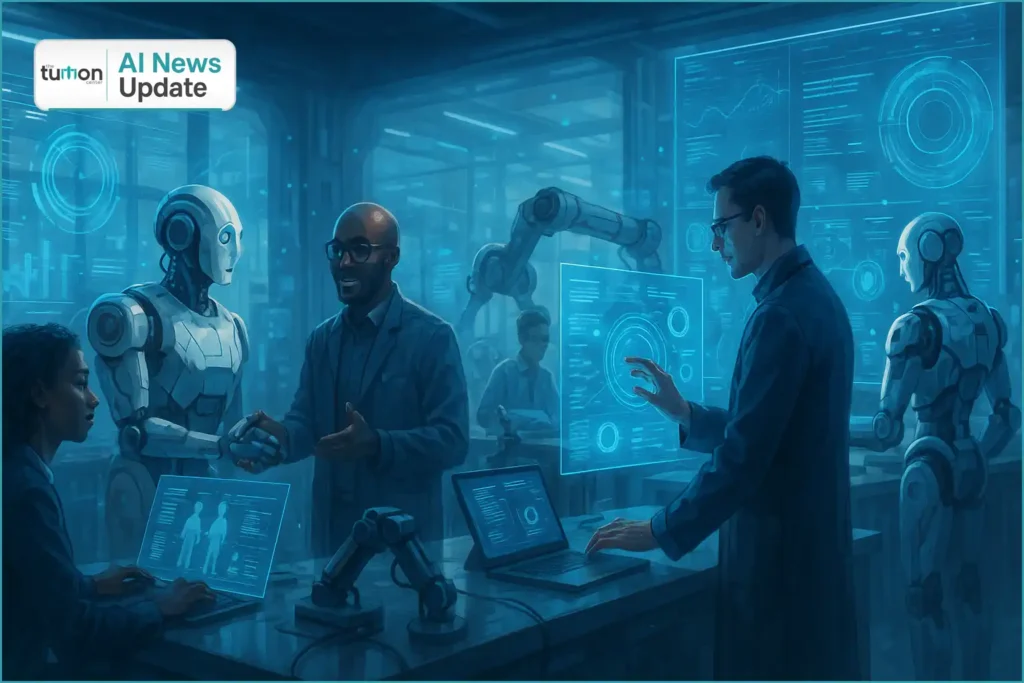
“The future of AI is not about replacing humans; it’s about amplifying human potential.” – A call to build technology that serves, uplifts, and empowers.
Key Takeaway: Fei-Fei Li’s message reframes AI not as competition, but as collaboration — a mirror reminding us that intelligence, in its truest form, is human-centered.
- Speaker: Fei-Fei Li, Co-Director, Stanford Human-Centered AI Institute
- Theme: Collaboration between human intuition and machine intelligence
- Impact: Inspires a generation to design AI that serves humanity, not replaces it
Introduction
In a world obsessed with speed, automation, and synthetic intelligence, **Fei-Fei Li’s words echo as a moral compass**. Her quote — “The future of AI is not about replacing humans; it’s about amplifying human potential” — cuts through the noise. It reminds us that progress is not defined by algorithms alone, but by how they empower human imagination, empathy, and understanding. In 2025, as AI weaves itself into every profession, classroom, and creative studio, her message has never been more urgent.
Li’s philosophy isn’t abstract idealism. It’s a grounded vision backed by research, ethics, and humanity. As a cognitive scientist and one of the pioneers of computer vision, she has witnessed firsthand how machines learn to “see.” Yet she insists that the ultimate vision must remain human: one that values inclusion, fairness, and curiosity above competition.
Understanding the Quote
To “amplify human potential” means using technology to *extend* our senses, not *replace* them. A teacher with AI becomes a personalized mentor to hundreds of students. A doctor with AI becomes an early-diagnosis hero. An artist with AI becomes a universe-builder. The human remains the composer; AI becomes the orchestra.
Li’s statement challenges the binary fear of “AI vs. human.” Instead, it invites a partnership model: AI × Human. When tools are built ethically, with transparency and empathy, they enhance our strengths — creativity, compassion, and reasoning — instead of dulling them.
The Human-Centered Vision
Fei-Fei Li co-founded the **Stanford Human-Centered AI (HCAI) Institute** to ensure that technology development never loses sight of its moral core. The institute’s work spans fairness in algorithms, data privacy, healthcare applications, and education. It advocates for *responsible intelligence* — systems that are explainable, inclusive, and designed with social well-being in mind.
Human-centered AI doesn’t mean slower AI; it means *wiser* AI. The idea is to pair human values with machine precision. For example, an AI tutor should adapt to each student’s pace rather than forcing uniform metrics. A hiring algorithm should eliminate bias, not amplify it. A robot caregiver should assist the elderly with dignity, not replace emotional contact.
AI and Education: Amplifying Curiosity
In classrooms, Fei-Fei Li’s philosophy translates into new pedagogy. AI becomes a *co-teacher* — analyzing progress, recommending resources, translating content, and sparking personalized exploration. It enables *curiosity at scale.* A child in Nairobi and a student in New York can both experience the same immersive AI science lab in virtual reality, guided by adaptive tutors that learn their interests.
For educators, this shift is liberating. Instead of spending hours grading or preparing slides, teachers can spend more time *mentoring* and *connecting*. AI handles logistics; humans handle hearts. This redistribution of effort is what Li means by amplification — turning human empathy into the centerpiece of technology-enabled education.
AI and Creativity: The Renaissance Reimagined
Artists and writers increasingly use AI tools like Runway, Midjourney, and ChatGPT to co-create. But the fear that “AI will replace creativity” misunderstands Li’s point. The goal isn’t to produce more content; it’s to expand creative possibility. When a painter visualizes an emotion through an AI-generated landscape, or when a filmmaker storyboards through generative tools, the technology amplifies vision — it doesn’t author it. The soul remains human.
In this sense, Fei-Fei Li’s quote is revolutionary. It tells creators to stop competing with machines and start collaborating with them. The AI age isn’t the death of originality; it’s the rebirth of imagination.
AI and Empathy: Designing with Heart
Li frequently highlights empathy as the most underrated skill in technology design. She argues that **technical literacy must evolve into ethical literacy.** For instance, when designing AI for healthcare, engineers must understand the emotional stakes of diagnosis. When developing educational models, they must consider how bias affects opportunity. Amplifying human potential, therefore, means integrating compassion into code.
AI systems trained with diverse datasets and transparent goals can bridge inequities instead of widening them. They can serve the elderly, support people with disabilities, translate across cultures, and preserve endangered languages. The future she envisions is one where *inclusivity is innovation.*
Expert Insights
“If we want AI to represent humanity, we must first make sure humanity is represented in AI.” — Fei-Fei Li, 2024 Stanford HCAI Summit
“AI will not take your job. A person using AI will.” — Andrew Ng, reflecting on Li’s collaborative vision
“AI literacy must include emotional intelligence. The next generation of coders must also be philosophers.” — Dr. Sarah Park, MIT Media Lab
Global and Social Dimensions
Fei-Fei Li’s quote has rippled across policy boards, universities, and corporations. In Europe, it inspired several initiatives on “trustworthy AI.” In Africa and Southeast Asia, her emphasis on inclusion has sparked mentorship programs training women and underrepresented groups in machine learning. In Silicon Valley, the message is influencing company charters that prioritize well-being over speed.
Even within business, leaders are realizing that ethical AI isn’t just moral — it’s strategic. Customers trust transparent systems. Employees thrive in purpose-driven organizations. Investors reward sustainability. Amplifying human potential has become not just a moral direction, but an economic one.
Challenges & Counterpoints
Of course, amplifying potential is easier said than coded. Data bias, algorithmic opacity, and profit-driven acceleration threaten the human-centered ideal. Too many systems are still trained on unbalanced data, reproducing inequality. Some companies treat “ethics” as branding, not backbone.
Li herself acknowledges this tension. That’s why she pushes for *interdisciplinary collaboration* — bringing sociologists, artists, and philosophers into AI labs. The more diverse the minds shaping models, the closer we get to amplifying collective potential instead of automating narrow perspectives.
Policy, Research & Education
Governments and universities are beginning to embed human-centered AI principles into policy. Stanford’s curriculum now integrates philosophy and ethics alongside coding. The OECD’s “AI in Education” framework references Li’s work, promoting tools that enhance well-being and creativity. UNESCO’s 2025 recommendations emphasize equitable access and inclusive data — the exact essence of her philosophy.
For students and researchers, this means a new literacy: *understanding humans as deeply as you understand machines.* The best AI engineers of the next decade will likely be storytellers, psychologists, or educators as much as programmers.
Future Outlook (3–5 Years)
- Rise of Empathy Engineers: New career paths blend psychology, ethics, and coding to design compassionate systems.
- AI Literacy for All: By 2028, global school curricula will teach human-centered AI as a core subject alongside math and science.
- Purpose-Driven Startups: Ventures will compete not just on accuracy, but on social impact and fairness metrics.
Conclusion
Fei-Fei Li’s quote reminds us that the most advanced technology still depends on timeless wisdom. AI is a mirror — it reflects what we put into it. If we build it with empathy, it will amplify empathy; if we build it with greed, it will amplify greed. The future belongs to those who choose wisely. For every student, teacher, and innovator reading this: don’t fear AI. Shape it. Teach it what it means to be human. In doing so, you’re not just building technology — you’re building the next chapter of humanity itself.