
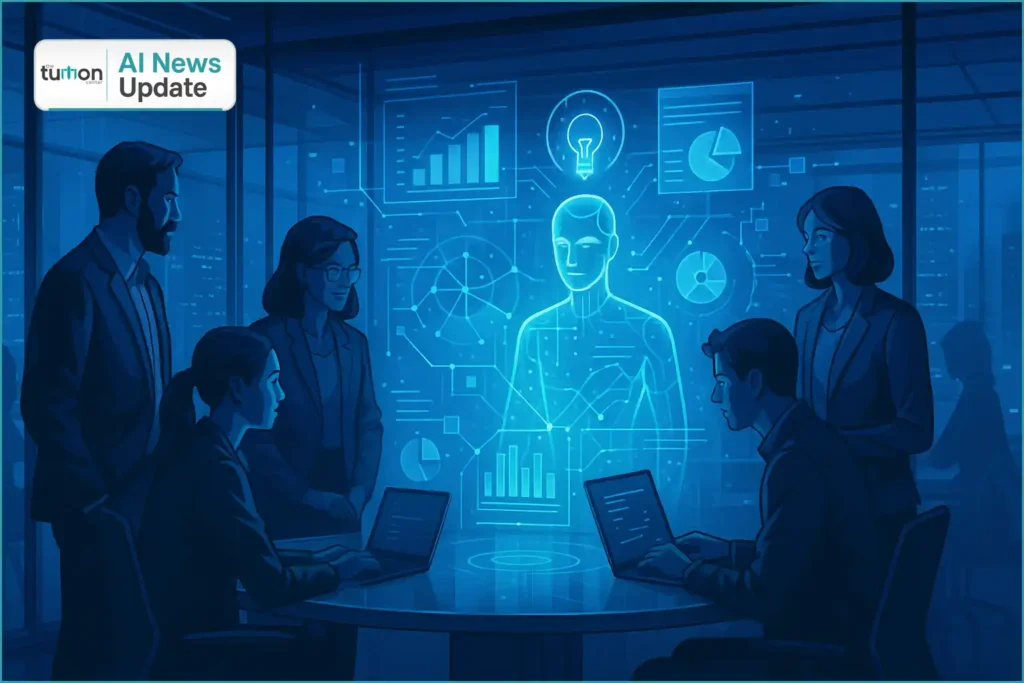
More than a chatbot, Gemini Enterprise is Google’s vision of a unified AI partner—merging reasoning, creativity, and collaboration across business and education.
- Google’s multimodal Gemini models interpret text, voice, image, and video in one reasoning layer.
- Integrated across Workspace, Education, and Cloud platforms for organizations worldwide.
- Represents the shift from “AI assistants” to “AI collaborators.”
Introduction
In the AI-powered decade, productivity is no longer measured by output but by insight. As humans increasingly collaborate with intelligent systems, Google’s Gemini Enterprise stands at the forefront of this revolution—a platform that doesn’t just assist users but amplifies their creativity, reasoning, and strategic thought.
Introduced as part of Google’s broader Gemini ecosystem, the Enterprise version represents a full integration of multimodal AI into the daily workflow of professionals, educators, and students. It’s not a single app, but an intelligent fabric woven across tools we already use—Docs, Sheets, Meet, Gmail, and more.
“We’re moving from search and suggestion to collaboration and co-creation,” said Sundar Pichai during the Gemini 2.0 rollout. “Gemini Enterprise embodies the next phase—AI as a thought partner.”
From classrooms to corporate boardrooms, this “AI thought partner” is changing the way people think, communicate, and make decisions.
Key Developments
At its core, Gemini Enterprise is powered by Gemini 2.0 Ultra, a multimodal model capable of reasoning over text, images, video, and code in real time. Unlike earlier models, Gemini doesn’t switch between modalities—it fuses them. This means a user can upload a presentation, discuss its logic via voice, and instantly generate a data-driven visual recommendation—all in a single interface.
For education, Gemini for Education Suite enables teachers to create lesson plans, summarize readings, assess student writing, and even simulate interactive debates. Students can upload notes and videos, receive instant feedback, and generate research insights within ethical guidelines.
In enterprise settings, Gemini integrates directly with Google Workspace, providing contextual understanding of organizational data (when permitted). It drafts policy briefs, visualizes metrics in Sheets, and crafts tailored presentations in Slides—all aligned with an organization’s tone and privacy framework.
Impact on Industries and Society
The introduction of Gemini Enterprise is catalyzing a new wave of hybrid productivity where human creativity merges with computational reasoning. For educators, it saves time while enabling richer feedback. For businesses, it transforms strategy meetings into collaborative problem-solving sessions with AI copilots visualizing real-time insights.
Healthcare professionals use Gemini to summarize medical records and research findings; legal teams analyze contracts with contextual reasoning; researchers synthesize academic literature within minutes. The economic ripple is immense—studies project an additional $1.2 trillion in annual global productivity gains through AI copilots by 2030.
Most significantly, Gemini Enterprise lowers the AI barrier for small enterprises, NGOs, and educational institutions—offering enterprise-grade intelligence without the need for coding or custom infrastructure.
Expert Insights
“Gemini represents a shift from information retrieval to knowledge orchestration,” says Dr. Meredith Whittaker, President of Signal Foundation and AI ethicist. “The challenge now is not capability—but accountability.”
Ethicists and educators alike emphasize the need for transparency in how AI tools process institutional data. Google’s commitment to on-device processing, data separation, and consent-based integration is a step toward responsible innovation.
“Gemini is teaching us how to teach machines responsibly,” notes Professor Shailendra Gupta of IIT Delhi. “It’s also teaching us how to learn with them.”
India & Global Angle
India has embraced Gemini’s ecosystem rapidly through Google’s partnerships with the Ministry of Education and Digital India. Universities like IIT Madras and IIIT Hyderabad are using Gemini Education APIs for curriculum automation and AI literacy training. Startups in Bengaluru and Hyderabad are leveraging Gemini Cloud to build domain-specific copilots in law, finance, and media.
Globally, Gemini Enterprise competes with platforms like Microsoft Copilot, Anthropic’s Claude Workbench, and OpenAI’s ChatGPT Team. Yet, its open integration model and deep ties to Android, Workspace, and YouTube Learning give it unmatched reach—especially in the developing world.
Educational NGOs in Africa and Southeast Asia are using Gemini Lite (a scaled-down version) to translate learning materials in real time, helping bridge linguistic and accessibility barriers for millions of students.
Policy, Research, and Education
Google’s partnership with UNESCO and OECD AI Futures focuses on developing ethical frameworks for AI use in education. This includes bias audits, cultural-contextual testing, and teacher training programs in over 30 countries. Gemini also aligns with India’s National AI Mission and PM e-Vidya initiative, promoting digital inclusion.
On the research side, Google DeepMind’s AlphaCode 2 and Gemini Pro are being used to generate safe, explainable code for educational software and civic data dashboards. This marks a key evolution: AI not just as toolmaker but as co-educator.
Challenges & Ethical Concerns
Gemini’s scale and access raise legitimate concerns. Privacy advocates warn that enterprise AI tools, if mishandled, could lead to inadvertent data leaks or biased decision-making. Google has responded by implementing layered consent, domain isolation, and audit logs for enterprise clients.
Another debate surrounds intellectual authorship. When AI drafts business proposals or student essays, where does human ownership begin and end? The global education community is developing digital watermarking systems and honor codes for fair AI collaboration.
“Ethics cannot be retrofitted—it must be preloaded,” says Professor Kate Crawford of USC. “The success of Gemini will depend on whether we can teach responsibility faster than we teach automation.”
Future Outlook (3–5 Years)
- Universal AI Integration: Gemini will become an invisible collaborator, embedded in every workflow—from classrooms to corporate analytics.
- Explainable Copilots: AI assistants will provide transparent citations and reasoning for every suggestion made.
- Global Digital Literacy: AI education frameworks will make responsible use part of basic schooling worldwide.
Conclusion
Gemini Enterprise symbolizes a future where intelligence is not owned but shared. It is less a product and more a partnership between human insight and machine precision. For students, it’s a mentor; for professionals, a co-strategist; for society, a mirror reflecting what collaboration could truly mean in the digital century.
As the world adapts, one truth stands clear: the most powerful feature of Gemini isn’t its multimodality—it’s its humanity. In its design, we glimpse the next frontier of learning: intelligence that understands, assists, and inspires.
#AI #Gemini #GoogleAI #FutureOfWork #DigitalTransformation #AIInEducation #AIForGood #LearningWithAI #TheTuitionCenter