
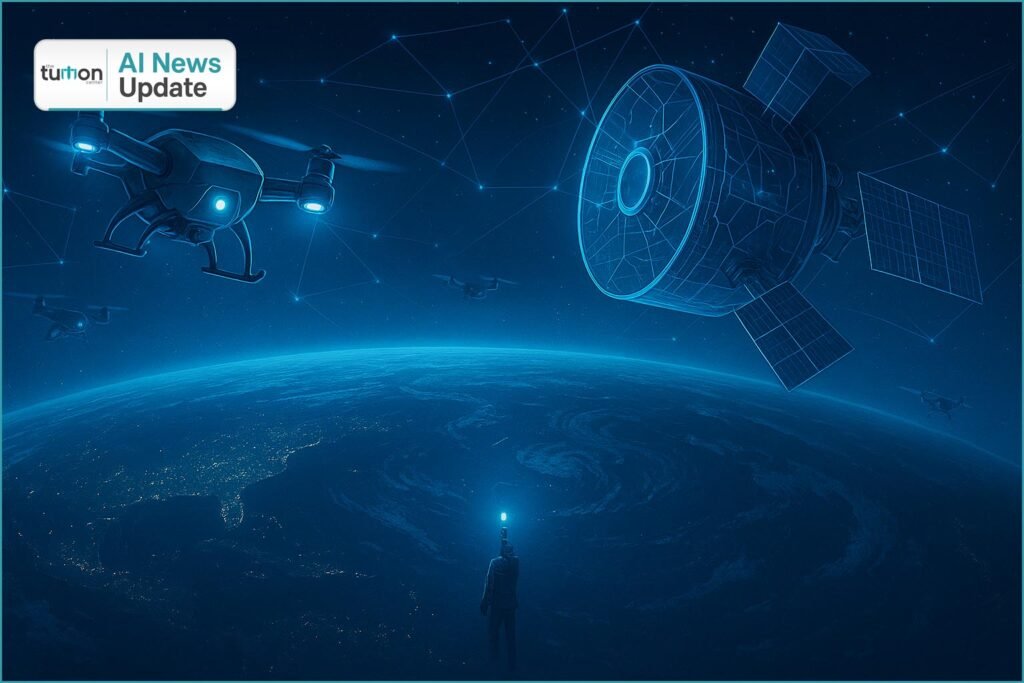
From tracking climate patterns to cutting industrial waste, artificial intelligence is quietly becoming the planet’s most unexpected ally.
- UNEP reports AI-enabled monitoring cut deforestation alerts by 37 % in pilot regions across Brazil and Indonesia.
- Google DeepMind’s “MetForecast” model improved 10-day climate prediction accuracy by 25 %.
- India’s Ministry of Power launched an AI-energy-efficiency dashboard expected to save 15 billion kWh annually by 2027.
Introduction
The story of AI has often revolved around jobs, creativity, and productivity—but another, quieter revolution is taking place: **AI for the planet**. As global warming accelerates and natural resources strain under consumption, data becomes the new oxygen for survival. Artificial intelligence, long seen as a consumer of energy, is now turning into a conservationist—helping predict floods, monitor forests, optimise power grids, and restore fragile ecosystems. This transformation marks the rise of “Green Intelligence.”
Key Developments
AI-powered climate forecasting
DeepMind’s 2025 model “MetForecast” made global headlines for out-performing traditional numerical climate simulations. Using transformer architectures trained on decades of satellite and atmospheric data, it predicts storms and rainfall patterns up to 10 days ahead—critical for agriculture, disaster management and logistics. By combining physics-informed learning with pattern recognition, the model promises faster, cheaper and greener forecasting.
Smart conservation networks
The United Nations Environment Programme (UNEP) confirmed that AI-driven sensors, drones and predictive analytics now power a global deforestation alert system covering the Amazon, Congo and Southeast Asia. Trained on millions of satellite images, these models detect illegal logging hours after activity begins—allowing rapid intervention. This single intervention reduced alert lag times by 37 % and prevented thousands of hectares of forest loss.
Energy optimisation and smart grids
In India, AI is reshaping the energy sector. The Ministry of Power’s AI-efficiency dashboard, launched in mid-2025, integrates IoT data from power plants, substations and renewable sites. Machine-learning algorithms analyse demand–supply variation, heat efficiency and transmission losses in real time. Officials expect to save 15 billion kWh annually—equivalent to the yearly electricity use of 12 million homes—while cutting 8 million tonnes of CO₂ emissions.
AI for ocean health
Global research collectives such as OceanMind and Microsoft’s Planetary Computer are applying deep learning to marine conservation. Models now track illegal fishing fleets, map coral bleaching, and identify pollution plumes through spectral imagery. By connecting these datasets, AI offers the first truly global, dynamic picture of ocean ecosystems—something impossible even five years ago.
Impact on Industries and Society
The integration of AI into environmental management has ripple effects across industries and education:
- Energy and utilities: Predictive maintenance and optimisation slash waste and carbon output.
- Agriculture: Precision-farming platforms use satellite and sensor data to minimise fertiliser and water use.
- Insurance & finance: Climate-risk AI models help insurers and banks price sustainability into their portfolios.
- Education & skilling: Sustainability analytics, geospatial AI and environmental data science are emerging as new interdisciplinary career tracks.
Expert Insights
“AI will not replace environmental scientists—it will supercharge them, turning terabytes of chaotic data into actionable insight.” — Inger Andersen, Executive Director, UNEP
“We’ve reached a moment where digital intelligence must serve ecological intelligence. The next breakthrough is not smarter code, but a smarter planet.” — Demis Hassabis, CEO, DeepMind
India & Global Angle
India is emerging as a hub for AI-for-climate innovation. The Indian Institute of Science and IIT Madras have both launched AI sustainability labs focusing on monsoon prediction, biodiversity mapping and urban air-quality management. Government partnerships with startups like BlueSky AI and SatSure aim to combine satellite imagery and predictive analytics for flood forecasting and sustainable irrigation.
Globally, Europe’s “Green Digital Twin of Earth” and NASA’s Earth AI Hub are creating open frameworks for climate data sharing. Together, these efforts show a shift toward planetary-scale collaboration where AI models work as guardians of ecosystems, not extractors of profit.
Policy, Research, and Education
Policymakers now face a dual challenge: encourage AI innovation while ensuring environmental accountability. Sustainable computing practices—such as carbon-neutral data centers and low-energy model training—are gaining traction. Universities are responding with cross-disciplinary degrees: Environmental Data Science, Climate AI, and Geo-Intelligence. For educators at TheTuitionCenter.com, this trend demands curriculum updates linking AI literacy with ecological ethics.
Challenges & Ethical Concerns
- Energy cost of AI itself: Training large models still consumes enormous electricity; without green power, climate gains could be offset.
- Data colonialism: Many biodiversity datasets come from the Global South but are monetised elsewhere; equitable data ownership must be ensured.
- Over-reliance on automation: Conservation still needs human rangers, scientists and community knowledge—AI must support, not supplant them.
- Transparency: AI decisions in climate finance or conservation policy must be interpretable and auditable.
Future Outlook (3–5 Years)
- “Green AI” principles—low-carbon model training and lifecycle audits—become standard across tech firms.
- Environmental twins of major cities enable real-time pollution and resource management dashboards.
- Global open-source “Eco-AI Commons” emerges, democratising sustainability algorithms for all nations.
Conclusion
AI began as humanity’s quest for intelligence—but its true legacy may lie in empathy. When algorithms learn to listen to rivers, forests and skies, we cross a new frontier of civilisation. For students, educators and innovators, the mission is clear: master technology that heals, not harms. The planet doesn’t need more code—it needs more conscience in code. The next decade belongs to **Green Intelligence**.