
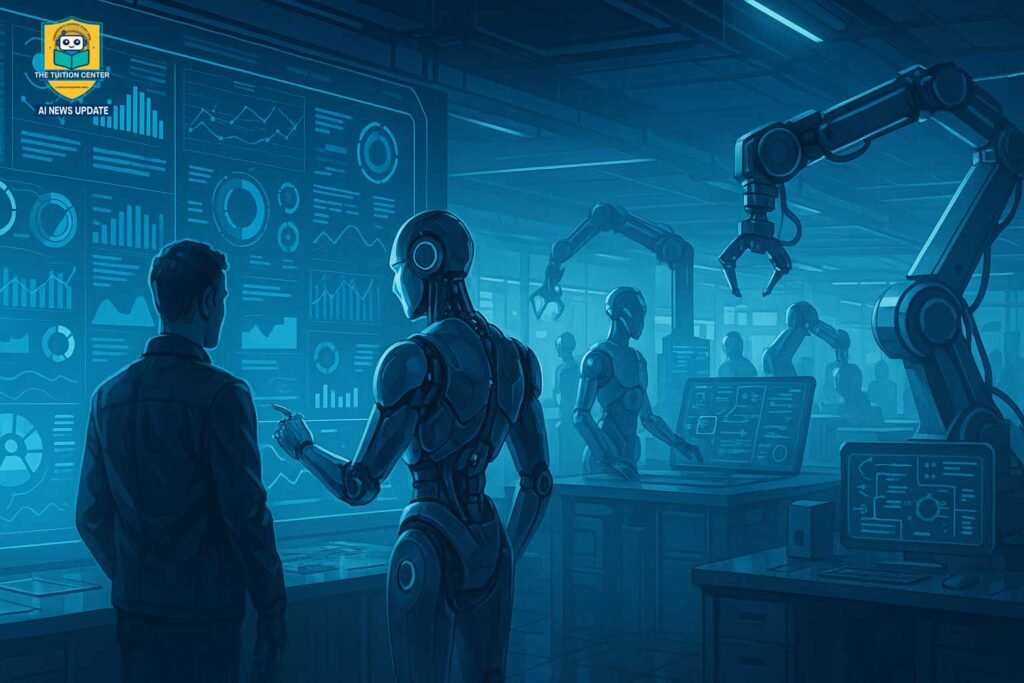
The Invisible War: How AI Is Transforming Cybersecurity, Warfare, and Global Digital Defense
The world’s next major conflict may not begin with missiles or armies — but with algorithms. AI is redefining global security, cybersecurity, military strategy, and the future of warfare.
- Cyberattacks are now autonomous, faster, and more unpredictable due to AI.
- Militaries worldwide are integrating AI into drones, logistics, surveillance, and battlefield strategy.
- Global security now depends on AI-powered defense systems more than traditional weapons.
Introduction
In the 20th century, nations fought with guns, tanks, and aircraft.
In the early 2000s, wars shifted to drones and data.
Today — in 2025 — conflict has entered a new domain:
AI-driven warfare and digital battles fought at invisible speeds.
While the public sees AI through entertainment, education, healthcare, or business, cybersecurity experts and defense forces see it as something far more serious —
a weapon, a threat, and a shield.
The rise of AI in warfare is not theoretical. It is happening now.
Nations are silently competing to build systems capable of:
- autonomous cyberattacks
- real-time threat prediction
- AI-powered surveillance
- robotic military units
- deepfake disinformation campaigns
This is the **invisible war** — a new era of conflict without gunfire, fought in code, algorithms, and networks.
The Rise of AI-Powered Cybersecurity
1. Real-Time Threat Detection
Traditional cybersecurity took minutes or hours to detect attacks.
AI does it in **milliseconds**, scanning billions of signals across:
- network traffic
- financial transactions
- user behavior
- cloud systems
- supply chain endpoints
AI-driven systems like DeepMind’s CyberShield and Microsoft’s AI Sentinel now detect attacks before they cause damage.
2. Predictive Defense
AI studies past attacks and predicts future ones — identifying weak points before hackers do.
3. Automated Incident Response
Modern intrusion systems can:
- contain breaches automatically
- isolate infected devices
- block malicious traffic
- reroute operations to safe channels
Machines now fight machines.
4. AI-Enhanced Ransomware Defense
Ransomware has become the world’s biggest cyber threat. AI can detect encryption behavior instantly, stopping attacks that would
previously shut down entire companies.
AI as the New Battlefield Weapon
1. Autonomous Drones
Drones capable of:
- identifying targets with computer vision
- navigating without GPS
- coordinating in swarms
- executing missions without pilot input
This changes warfare from human-controlled to AI-managed.
2. AI Command & Control Systems
AI analyzes battlefield data 100× faster than human commanders, recommending:
- defense routes
- troop positioning
- logistics optimization
- enemy patterns
The US, India, Israel, and South Korea are testing such systems.
3. AI-Driven Surveillance
Advanced computer vision can identify:
- military movements
- border intrusions
- satellite-level anomalies
AI surveillance is now more effective than entire teams of analysts.
4. Electronic Warfare
AI helps jam signals, confuse enemy drones, and intercept communications in real time.
The Dark Side: AI-Powered Threats
1. Deepfake Propaganda
Deepfakes can:
- spark riots
- influence elections
- manipulate public opinion
- damage reputations
- create diplomatic conflict
Governments now treat deepfake detection as national security.
2. Autonomous Malware
AI can generate new malware variants automatically, making them harder to detect.
3. Algorithmic Terrorism
Extremist groups may use AI for:
- recruitment messaging
- target selection
- communication encryption
4. AI-Driven Financial Attacks
AI can manipulate markets, trigger flash crashes, or exploit banking vulnerabilities.
India’s Role in AI-Driven Defense
India is rapidly adopting AI for national security:
- AI border surveillance towers
- autonomous drones for the army
- AI cyber defense units
- satellite AI for monitoring enemy movement
- NIA’s AI-based terror pattern analysis
India is positioning itself as a global leader in ethical and responsible defense AI.
Global Competition: The New Arms Race
The world’s most powerful nations are building AI arsenals:
- USA — battlefield AI, drone swarms, cyber defense
- China — AI surveillance, autonomous weapons
- Russia — cyber warfare and misinformation
- Israel — AI-driven targeting and prediction systems
- India — ethical, predictive, and pro-defense AI
Future of the Invisible War (3–5 Years)
- Autonomous cyber battles between AI systems
- Drone swarms controlled by AI command centers
- National digital shields powered by predictive models
- AI peacekeeping tools for preventing conflict
- Global treaties for AI weapon regulation
Conclusion
The future of warfare will not be decided by the size of armies, but by the intelligence of algorithms.
The nations that embrace AI defense — responsibly and ethically — will shape the next world order.
As AI becomes both weapon and shield, humanity stands at the edge of a new era:
a world where peace, security, and stability depend on digital vigilance more than physical force.
The invisible war has already begun — and the future belongs to those who can defend the invisible.
#AI #Cybersecurity #AIWarfare #DigitalDefense #FutureTech #AIInnovation #TheTuitionCenter