
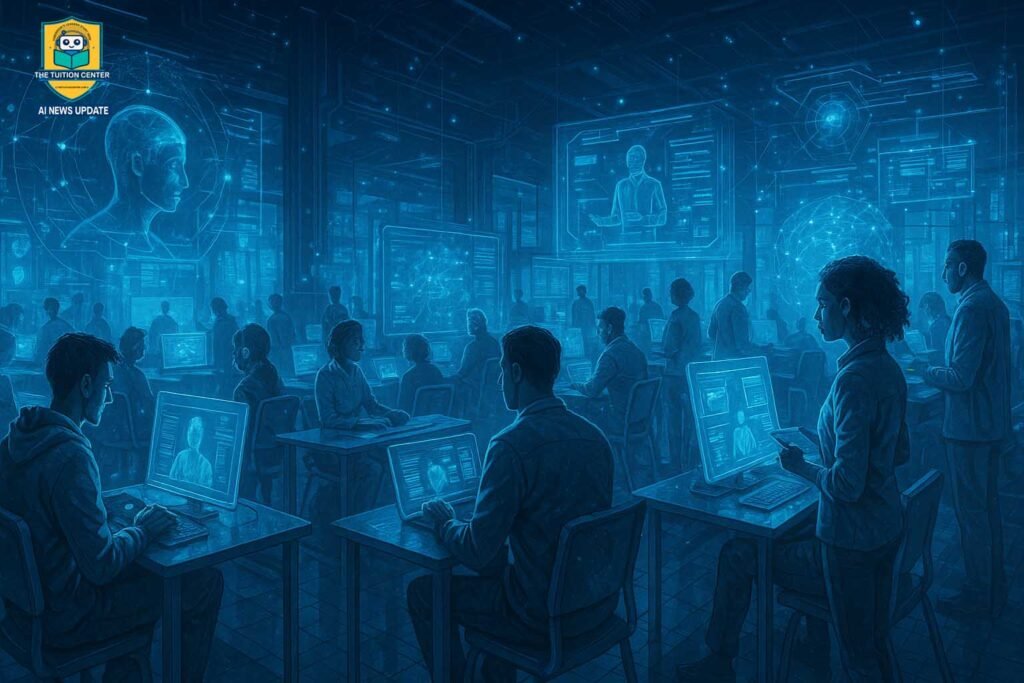
The AI Skills Revolution: How the Global Job Market Is Transforming Faster Than Universities Can Adapt
In 2025, the world entered a new era where AI skills—not degrees—define employability, growth, and global competitiveness.
- 88% of companies now prefer skill-based hiring over traditional degrees.
- The global AI-skills workforce gap crossed 42 million in 2025.
- Over 300 million workers must upskill or reskill with AI by 2030 to remain employable.
Introduction
The world has seen many skill revolutions—agricultural, industrial, computer, and digital. But none compare to the speed and scale of the AI revolution of 2024–2025.
For the first time, a technology is evolving faster than universities can update their curriculum, faster than governments can draft policy, and faster than workers can adapt.
AI is not just automating tasks—it is redefining what “skills” mean.
Workers are now expected to know:
- AI tools
- automation workflows
- prompt engineering
- AI data literacy
- multi-agent orchestration
- AI-integrated problem solving
while universities still teach outdated syllabi designed for the pre-AI era.
Key Developments
1. Companies Shift to Skills-First Hiring
Google, Infosys, TCS, Reliance, JPMorgan, Siemens, IBM, and thousands of global firms now prioritise skills over degrees.
Hiring managers look for:
- AI-supported problem solving
- workflow automation abilities
- AI-based research and analysis
- multi-language AI communication
This has democratized job access for millions.
2. AI Upskilling Platforms Become Global Lifelines
Workers use AI-driven learning platforms for:
- job simulations
- micro-courses
- personalized skill-building paths
- AI interview practice
These platforms train workers 4–10x faster than traditional classrooms.
3. New Careers Explode Across Industries
2025 saw the rise of roles such as:
- AI workflow designer
- automation strategist
- AI content engineer
- multi-agent supervisor
- AI ethics auditor
- synthetic media producer
None of these existed five years ago.
4. Universities Fail to Keep Pace
Traditional academic institutions still operate on slow update cycles—often taking 3–5 years to refresh curriculum.
AI, meanwhile, updates every 3–5 weeks.
This mismatch has left graduates underprepared and companies frustrated.
Impact on Industries and Society
1. The Rise of the “AI-Augmented Employee”
Modern workers use AI for:
- research
- data processing
- coding
- customer support
- design
- content creation
- market analysis
This boosts productivity 500–1200% depending on industry.
2. SMEs Gain a Competitive Edge
Small businesses leverage AI tools to perform tasks once reserved for large corporations, including:
- marketing automation
- customer analytics
- global sales outreach
- product design
3. The Middle-Skill Workforce at Risk
Roles like data entry, customer service, administrative support, and low-level IT tasks face rapid automation.
Reskilling is not optional—it is survival.
4. Students Are Redefining Career Choices
Teenagers are choosing:
- AI arts
- AI mechatronics
- AI entrepreneurship
- AI-powered freelancing
over traditional engineering or MBA career paths.
Expert Insights
“We are witnessing the biggest skill shift since the industrial revolution. Every job is becoming an AI job.” — Prof. Mikhail Alvarez, Future of Work Institute
“Degrees matter less; capabilities matter more. Those who learn AI tools will lead the next decade.” — Dr. Radhika Nair, Indian School of Skills & Innovation
India & Global Angle
India is at the center of the global AI-skilling wave:
- largest young workforce
- mass adoption of digital public infrastructure
- government-backed skill missions
- fastest-growing EdTech ecosystem
Globally, major AI-skilling movements are happening in:
- UAE (AI Skills Passport)
- Singapore (AI SkillsFuture 2.0)
- USA (AI Workforce Development Act)
- UK (National AI Talent Pipeline)
- South Korea (AI reskilling mandate)
Policy, Research, and Education
Governments are launching:
- AI-based national skilling platforms
- credentialing systems for micro-skills
- industry-academia joint skill councils
- AI literacy requirements for all schools
Universities adopt:
- AI-integrated syllabi
- industry-taught modules
- project-based skill development
but progress remains slow.
Challenges & Ethical Concerns
The skill revolution also raises questions:
- Will the skill gap widen between countries?
- Can low-skilled workers adapt quickly enough?
- How to ensure ethical, fair access to AI tools?
- Will AI-driven job displacement increase inequality?
Future Outlook (3–5 Years)
- AI credentialing will replace traditional degree requirements.
- AI tutors will teach job-ready skills to workers worldwide.
- Multi-agent AI workplaces will require new supervision roles.
Conclusion
The AI skills revolution is not a threat—it’s an opportunity.
The world is shifting from “job security” to “skill security.”
Those who master AI tools will lead industries, build new businesses, and create innovations that shape tomorrow.
This is the decade where learning becomes continuous, global, personalised, and AI-powered.