
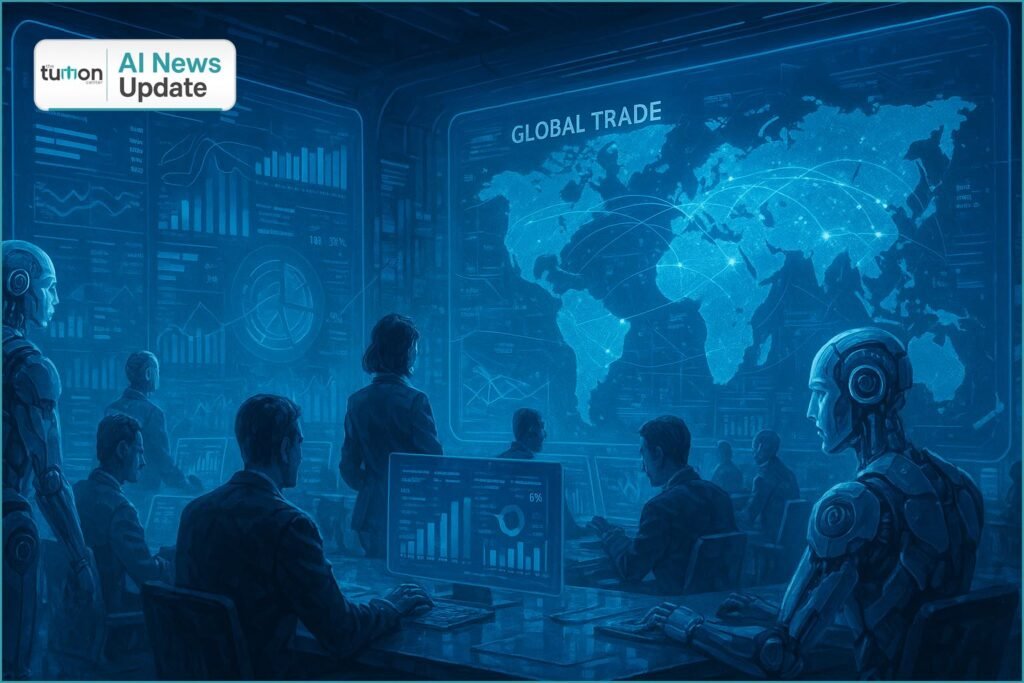
From trillion-dollar hardware valuations to evolving job-roles, AI is reconfiguring business, labour and the global economy.
- The global AI market value is projected at ~US$391 billion in 2025 and growing at a CAGR of ~31 %.
- 90% of tech workers now report using some form of AI in their jobs.
- Hardware supplier valuations (e.g., Nvidia reaching ~$5 trillion) signal enormous upstream investment that cascades through the economy. Introduction
Key Developments
A useful snapshot: according to recent statistics, roughly 1.8% of all new job-listings are specifically in the AI space as of 2025. Additionally, 90% of tech-workers report using some kind of AI in their daily jobs. The global AI market itself is valued at around US$391 billion with growth projected to multiply nine-fold by 2033.
On the business side, hardware and infrastructure companies are capturing massive value-pools. Nvidia’s achievement of a ~$5 trillion valuation is not just symbolic — it reveals how central AI compute has become to business value-creation.
Innovation is also shifting: Instead of companies building everything in-house, we’re seeing more ecosystem play: tooling, agent-platforms, domain-specific models, specialised compute-as-a-service. For example, new platforms are allowing smaller firms to train or fine-tune models without owning massive infrastructure — democratising access and altering competitive-dynamics.
Impact on Industries and Society
In **business**, AI adoption can mean increased efficiency (automation of routine tasks), better decision-making (augmented analytics) and new service-models (AI-agents, subscription services, personalised experiences). Companies that don’t adapt risk being disrupted by more agile players.
In **jobs**, the picture is mixed. While some roles may become obsolete, many will transform — requiring new skills such as AI-agent supervision, data ethics, hybrid human-AI workflows, continuous learning. For students and career-switchers, this means emphasis on adaptability, lifelong learning and domain-plus-AI capability.
On the **economy**, large-scale AI investment means more capital flow into data-centres, semiconductors, software platforms, connectivity. This can create new clusters (cities/regions as AI hubs), but also risks concentration of power and asset-control. For developing countries like India, this is a double-edged sword: opportunity to leapfrog, but also risk of being peripheral in value chains.
Expert Insights
“90% of tech workers now report using some form of AI in their job.” — Exploding Topics AI Statistics, Oct 2025.
This statistic emphasises a transition: AI tools are becoming part of the “normal” toolkit, not just the cutting-edge. For educators, this transforms curriculum-design: teaching “AI usage” is now essential, not optional.
India & Global Angle
India’s economy stands at a pivotal moment. With the “Digital India” mission, large young workforce, and rising AI-startup ecosystem, the country can harness the job-and-innovation wave. But the challenge is skills: ensuring that Indian students and workers are prepared for AI-augmented roles, not just replaced by automation. The focus should be on bridging domain expertise (education, healthcare, agriculture) with AI-tool fluency.
Globally, we also see value-chain shifts: hardware (GPUs), software (models), services (fine-tuning) each have different geographies of strength. Countries and firms that capture more of the stack will reap more economic benefit. Thus the ecosystem becomes strategic, not just technological.
Policy, Research & Education
Policy-makers should frame AI as both a technology and an economic strategy: supporting infrastructure investment, open access compute, public-private partnerships, reskilling programmes. Research must address how AI alters labour markets, income distribution and value-creation. Education institutions need to incorporate AI-plus-domain training, emphasise lifelong learning, micro-credentials and flexible pathways.
Challenges & Ethical Concerns
Several caveats merit attention: The rapid adoption of AI risks deepening inequality — between regions, between high-skilled and low-skilled workers. There is potential job displacement if reskilling doesn’t keep pace. Ownership of data and models concentrates power — forcing us to ask: who sets the rules, who benefits? For learners: tool-fluency without judgement can mean being replaced rather than empowered.
Future Outlook (3-5 Years)
- Hybrid job-roles will dominate: for example “AI-agent supervisor”, “model-ethics auditor”, “human-AI workflow designer”.
- Business models will shift from ownership of hardware and models to “AI-services as platforms” and “agent-ecosystem subscriptions”.
- Emerging economies like India will either become AI-talent hubs (if they invest in skills/infrastructure) or risk being downstream service providers. The strategic window is now.
Conclusion
For students, professionals and educators: think of AI not as an add-on, but as core to business and careers. Map your path: What domain do you want to work in (education, healthcare, finance, agriculture)? What AI-tools will that domain use? How can you gain the dual-capability of domain + AI-fluency? The future belongs to those who adapt not just to change, but who shape it. #BeThatPerson