
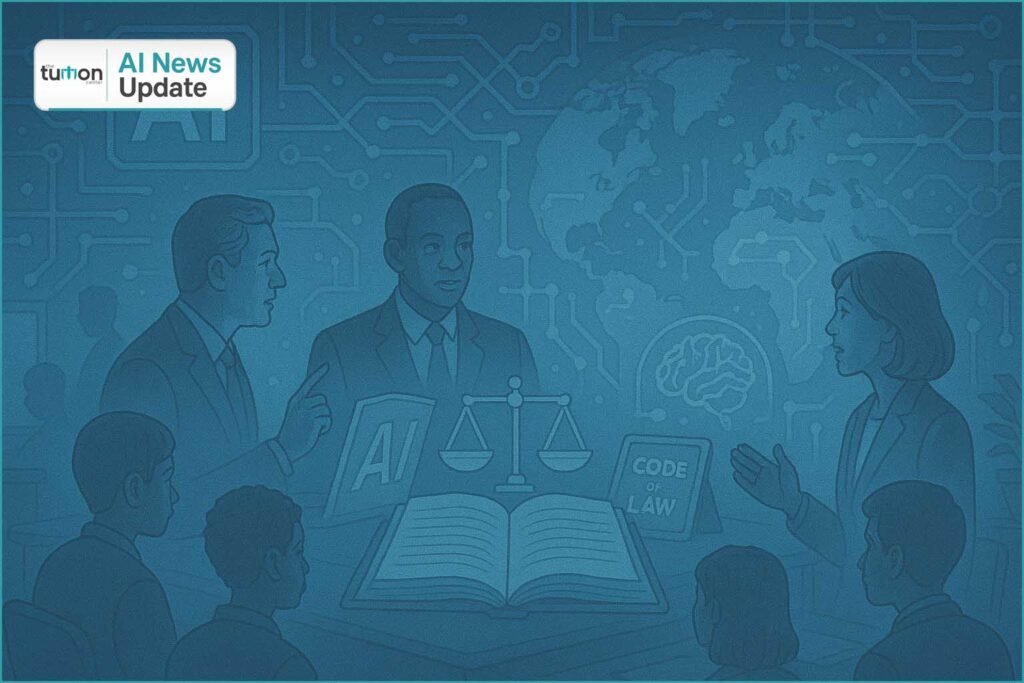
New framework aims to make AI adoption trustworthy while enabling growth across academia, startups and public service.
- The Ministry of Electronics & Information Technology (MeitY) released a draft of India’s AI Governance Guidelines in November 2025, emphasising the principle of “Do No Harm”.
- The guidelines present seven “Sutras” (principles) intended to guide AI deployment across sectors.
- The framework targets inclusive, trustworthy, and scalable AI adoption, bridging policy, research, industry and education.
Introduction
For years, India has been a major participant in the global AI race — from talent, engineers and adopters to large-scale digital platforms such as Aadhaar and UPI. But momentum alone is not enough. In 2025, the country is transitioning from rapid adoption toward thoughtful governance. With the release of the AI Governance Guidelines draft, India is declaring its intention to not just follow global AI trends — but to shape them. For students, educators and creators, this marks a shift: the aim is now to build AI that is not just cutting-edge, but responsible, inclusive and trusted.
“`
Key Developments
The Ministry of Electronics & Information Technology published a draft version of India’s AI Governance Guidelines in November 2025. These guidelines frame AI deployment through a lens of “Do No Harm”, emphasising both innovation and risk-management. The document outlines seven core principles or “Sutras” — a deliberate choice of Sanskrit metaphor to embed cultural resonance.
Beyond principles, the framework proposes risk-based lifecycle governance, alignment with international standards, and institutional mechanisms such as assurance frameworks, incident-reporting protocols and cross-sector collaboration. For example, the guidelines call for AI systems to be assessed for risk impact, transparency, fairness, safety and environmental footprint — not just performance and scale.
Impact on Industries and Society
What does this mean in practice?
- Education & Reskilling: AI curricula now need to integrate governance, ethics, lifecycle thinking and socio-technical awareness — not just model building. Educators should incorporate modules on “AI stewardship” and “responsible deployment”.
- Startups & Industry: Indian AI startups must design for compliance early: clear audit trails, ethical risk-management and inclusive design will become differentiators. Funding, partnerships and credentials will align with governance readiness.
- Public Service: Government systems (health, agriculture, citizen services) that adopt AI will now have a clearer governance regime — expect more partnerships, innovation lanes, but also accountability. For creators, new opportunities exist to build AI-governance training, auditing tools, compliance platforms.
- Society & Trust: For end-users and learners, this framework signals that AI isn’t just a toy or tool — it’s a system with responsibility. Building user-centric, fair, transparent applications becomes essential.
Expert Insights
“India’s approach here is pragmatic: the guidelines do not impose a heavy-handed ban, but rather steer innovation with guard-rails. That creates space for the ecosystem to grow — but within trusted boundaries.” — Policy researcher at NCAIC (paraphrased)
India & Global Angle
The guidelines place India in global conversation — bridging the gap between rapid adoption in emerging markets and high-governance standards in the West. The nation’s digital infrastructure (Aadhaar, UPI, Digital India) gives it unique advantage to operationalize governance at scale. India now ranks among the top in AI skill penetration globally, meaning the talent base exists
Globally, as more countries publish AI-governance frameworks, interoperability, cross-border data flows and standardisation become crucial. India’s emphasised alignment with international frameworks (e.g., ISO, NIST) signals it’s thinking ahead.
Policy, Research, and Education
The education sector must respond. Universities, edtech providers and training firms must incorporate governance, policy, ethics, audit-trails and lifecycle thinking into the AI curriculum. Researchers should align experiments with the “Sutras” and look at real-world governance metrics (fairness, transparency, footprint) not just model accuracy. Industry will need compliance tools, auditing frameworks and workforce skilling to manage the lifecycle of AI systems.
Challenges & Ethical Concerns
Even with strong intent, the framework faces obstacles:
- Implementation Gap: Guidelines are only the first step. The real work is in building institutional capacity, audits, real-world enforcement and market readiness.
- Innovation vs Regulation Tension: Too heavy regulation can stifle creativity, but too light regulation can lead to abuse. Finding the right balance will be hard in a fast-moving field.
- Resource & Infrastructure Constraints: Smaller players may struggle to meet assurance-framework demands; so governance could favour large organisations unless support is provided.
- Global Competitiveness: If governance becomes a bottleneck, India risks being slower than leaner competitors. For creators and educators, this means you must stay agile and build governance-aware skills early.
Future Outlook (3–5 Years)
- Governance-ready AI ecosystems will emerge in India: startups, universities and institutions aligned with the new rules will gain trust and traction.
- Curricula and certification around “AI governance” will become mainstream — modules for ethics, audit, transparency, lifecycle management will be as common as data-science fundamentals.
- India may become a global hub for “responsible-AI” development in emerging markets — exporting governance frameworks, building regional centres, partnering across South Asia and Africa.
Conclusion
This is a moment for you to reflect: if you’re creating AI content, teaching AI tools or preparing students for AI careers, ask yourself — do you understand not just how to build, but how to govern? The era of unchecked AI experimentation is over; we’re entering an era of accountable AI. For learners and creators in India and beyond, the advantage will go to those who can combine innovation with responsibility.
#AI #AIInnovation #FutureTech #DigitalTransformation #AIForGood #GlobalImpact #Education #LearningWithAI #TheTuitionCenter