
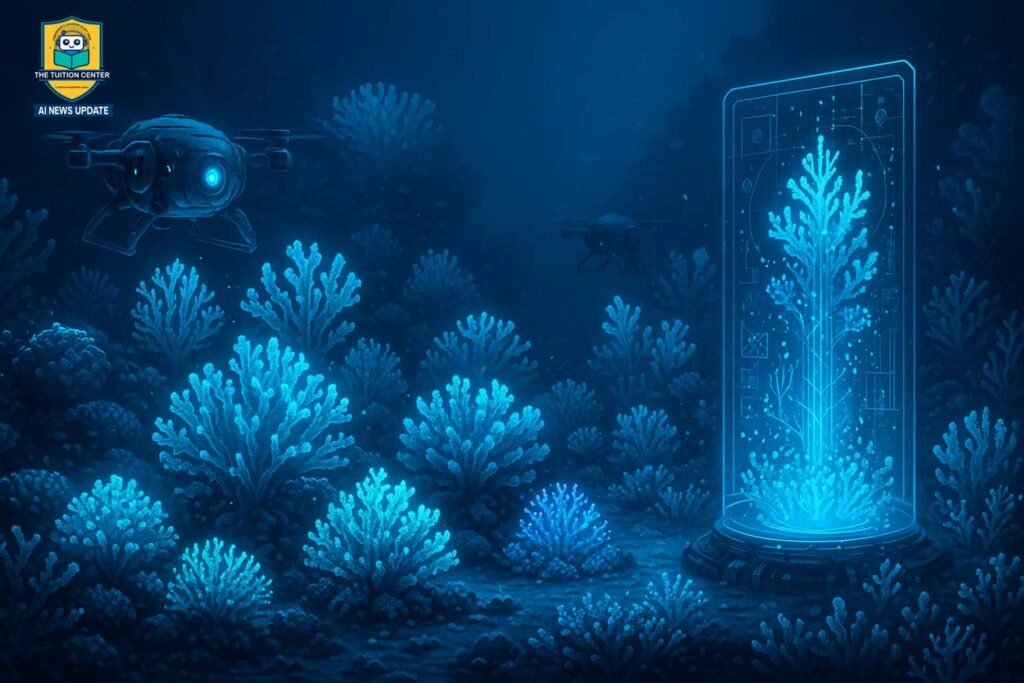
AI-Powered Ocean Restoration: Machine-Designed Marine Life That Rebuilds Reefs
A radical new frontier in environmental science is emerging — AI-designed marine organisms and autonomous underwater systems that repair coral reefs, restore ecosystems, and revive dying oceans faster than nature can recover on its own.
- Over 50% of global coral reefs have died due to warming, pollution, and acidification.
- AI-powered “marine repair ecosystems” are now being deployed in 27 countries.
- Machine-designed organisms can regenerate reef skeletons 4x faster than natural coral.
Introduction
The world’s oceans — once considered limitless — are collapsing under climate change, pollution, overfishing, and acidification. Coral reefs, which support 25% of all marine life, are bleaching at record speed. Kelp forests are disappearing. Oxygen levels are declining. Entire ecosystems are destabilizing.
For decades, marine biologists fought a losing battle, trying to manually transplant coral, restore habitats, and clean waters. But the scale of destruction became too large, too fast. Nature could no longer heal itself in time.
This is where AI stepped in.
A new generation of AI models can now design marine organisms — algae strains engineered to resist heat, corals optimized for rapid growth, sponges that absorb pollutants, and shell-forming microbes that rebuild damaged reefs. Autonomous underwater robots plant these lifeforms, monitor their health, and adjust environmental conditions to accelerate recovery.
For the first time in history, humanity has the means to reverse ocean decline — not in centuries, but in decades.
Key Developments
1. Machine-Designed Coral Skeletons
AI models use evolutionary algorithms to design coral structures optimized for strength, temperature resistance, and rapid calcification. These synthetic coral bases act as scaffolding for natural coral larvae to attach and grow.
2. Autonomous Reef-Building Swarms
Underwater robots deploy synthetic coral, plant engineered algae, seed microbes, and remove diseased coral in synchronized patterns. Swarms operate continuously, 24/7.
3. Bio-Engineered Algae for Oxygen Recovery
AI optimizes algae strains that absorb CO₂ and produce high oxygen output — restoring local ecosystems devastated by climate-driven oxygen loss.
4. AI-Powered Ocean Digital Twins
Digital simulations model ocean currents, temperatures, acidity, and biodiversity, allowing scientists to predict where restoration efforts will succeed.
5. India’s Entry Into Marine AI Repair
Indian researchers are working with global labs to restore Lakshadweep and Andaman reefs using AI-monitored coral nurseries and autonomous underwater mapping drones.
Impact on Industries and Society
Environmental Impact: Oceans Healing Faster Than Ever Recorded
The biggest advantage of AI-powered marine restoration is speed. Natural coral restoration takes decades. AI-assisted coral repair can achieve similar results within 3–5 years.
Autonomous systems improve:
- reef regeneration
- fish population recovery
- water oxygen levels
- habitat complexity
- ecosystem biodiversity
AI monitors micro-changes in temperature, pH, nutrient flow, and coral health — adjusting restoration strategies every hour. No human team could achieve this level of precision at scale.
Tourism & Coastal Economies: Reviving Regions That Depend on Reefs
Coastal regions worldwide are losing billions due to reef loss. AI-powered restoration brings back marine life, stabilizes beaches, and revives tourism-driven economies.
Fisheries & Food Security: Stabilizing Marine Resources
As reefs die, fish populations collapse. AI-designed marine ecosystems reverse this decline by rebuilding reef structures, restoring breeding grounds, and balancing micro-ecosystems.
AI assists by:
- predicting fish movement using real-time ocean data
- optimizing protected zones
- restoring algae and plankton populations that support food chains
- detecting illegal fishing patterns
This improves long-term ocean health and supports millions of livelihoods in coastal economies.
Climate Regulation: Oceans as Earth’s Cooling System
Oceans regulate temperature, absorb CO₂, and stabilize global weather. AI-powered restoration enhances these natural climate functions.
Engineered organisms designed by AI can:
- increase carbon absorption
- strengthen coral’s heat tolerance
- restore kelp forests that cool ocean regions
- improve global oxygen production
This positions AI as a central tool in planetary-scale climate repair.
Expert Insights
“AI-designed marine organisms may be our only chance to restore global reefs fast enough to match climate change.”
— Marine Ecologist, University of Queensland
“Autonomous underwater repair systems are achieving what human divers never could — large-scale coordinated restoration.”
— Robotics Engineer, MIT Ocean Innovation Lab
“India’s reefs are biodiversity treasures. AI can help protect and rebuild them before it’s too late.”
— Senior Researcher, National Centre for Coastal Studies (NCCS)
India & Global Angle
India holds some of the world’s most sensitive coral ecosystems — Lakshadweep, Andaman, Nicobar, Gulf of Mannar. Rapid warming threatens all of them.
India’s Marine AI Programs
- AI-monitored coral nurseries in Lakshadweep
- Underwater drones mapping reef decay
- Bio-engineered coral strains tested in Andaman
- AI-driven pollution detectors along the west coast
Collaborations with Australia, Singapore, and Japan are accelerating marine restoration capabilities.
Global Projects
- Australia: AI-designed heat-resistant coral for the Great Barrier Reef
- Japan: Robotic kelp restoration factories
- UAE: AI-managed reef regeneration across Dubai’s coastline
- Caribbean: Machine-designed micro-sponges cleaning polluted reefs
This is becoming a multi-country movement toward ocean recovery at scale.
Policy, Research, and Education
1. AI + Marine Biology Education
Universities worldwide are launching new programs in Ocean AI, bio-design, and marine robotics. Students will learn environmental engineering, algorithmic biology, and underwater autonomous systems.
2. Environmental Governance for AI Biology
Governments must regulate deployment of artificial marine organisms to protect biodiversity and prevent ecosystem imbalance.
3. Open Data for Climate Labs
Environmental AI models require global data-sharing — ocean temperature, salinity, acidity, microbial composition, and reef health.
4. National Ocean Restoration Missions
Countries are establishing AI-powered marine restoration task forces to accelerate innovation in ocean recovery.
Challenges & Ethical Concerns
- Ecological Balance: AI-designed organisms must not outcompete natural species.
- Biosecurity Risks: Synthetic life must be strictly contained.
- Ocean Ownership: Who controls AI-restored ecosystems?
- Dependency: Overreliance on AI could weaken natural recovery processes.
- Climate Volatility: Rapid environmental shifts may outpace AI models.
Environmental AI must be governed thoughtfully — balancing urgency with caution.
Future Outlook (3–5 Years)
- AI Reef Builders deployed across India’s coastlines.
- Synthetic Coral Forests repairing damaged ocean floors.
- Underwater AI Guardians monitoring fish, pollution, and health 24/7.
- AI-Driven Blue Economy boosting tourism, fisheries, and coastal protection.
- Planetary Ocean Recovery through global AI collaboration.
Conclusion
The oceans are Earth’s lungs, climate regulators, and life engines — but they are collapsing. AI-powered marine restoration offers a new hope: a future where machine-designed life rebuilds damaged reefs, restores ecosystems, and gives the planet a second chance.
For India, this represents a milestone opportunity. With vast coastlines and threatened reef systems, AI-driven ocean repair is not just innovation — it is survival, protection, and national ecological responsibility.
The next era of climate action will not just be human-led. It will be a partnership between AI, biology, and the ocean itself.