
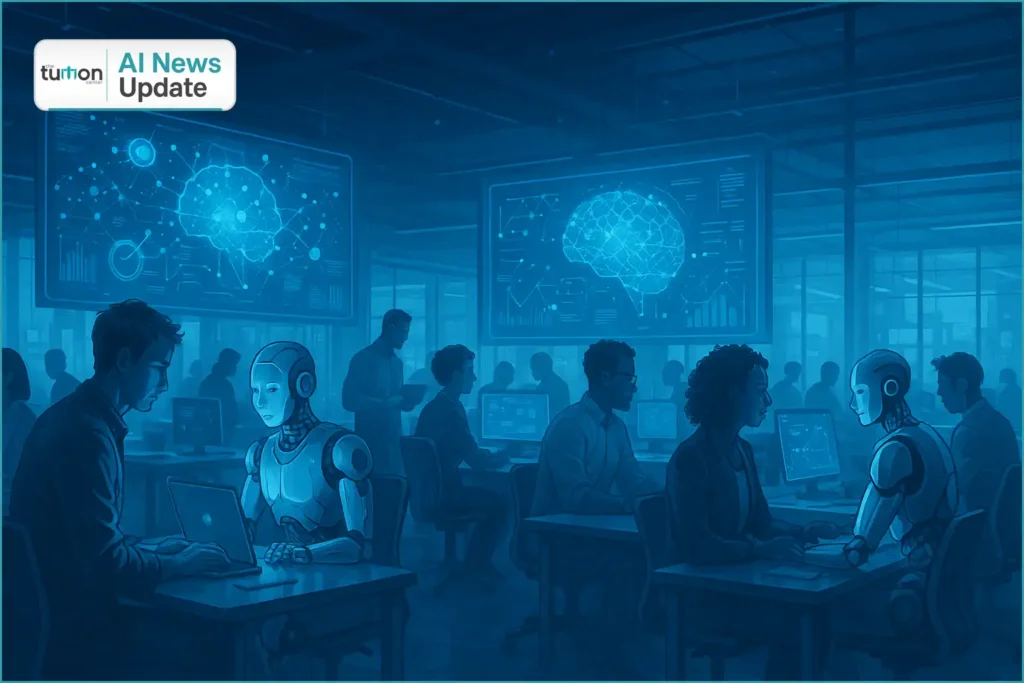
As AI reshapes how we learn, work and connect, the human question becomes central: how do we steer AI to serve people, not replace them?
- AI is accelerating beyond labs into daily lives and learning systems.
- Human-AI collaboration is becoming the norm—not just automation.
- We must ask hard questions: Who benefits? Who is excluded? What happens if we don’t consciously design the future?
Introduction
When you read about AI, the focus is often on speed, scale, capabilities: “faster models”, “more accurate predictions”, “fewer errors”. But the deeper question is rarely about what happens *to us*—to our roles, skills, relationships, learning. At TheTuitionCenter.com, we believe that the most important story is not which algorithm wins—but how humans adapt, lead and stay meaningful in a world shaped by AI. This is a discussion about humanity and AI—not just technology.
“`
Key Developments
We’re witnessing three parallel shifts:
- Shift from automation to augmentation. Early narratives saw AI as a replacement for human work. Now the emphasis is more on “human-AI teaming” — enabling humans to do more, better, with AI as a partner.
- Shift from AI for few to AI for many. Platforms and enterprise tools are making AI accessible to non-technical users, educators and small businesses. This opens the promise of broad human impact—but also the risk of uneven access and a new digital divide.
- Shift from technology-push to value-driven design. Increasingly, organisations ask: What value will this AI create for learners, for society, for individuals? The question of “why” matters as much as “how”.
Impact on Industries and Society
In education, this shift is powerful. It’s no longer enough to teach AI tools; we must teach how to *work with* AI. How to ask good questions, how to evaluate AI’s output, how to ensure fairness. In healthcare, business, policy and society, the human dimension is returning to the centre—not as an after-thought but as the guiding principle.
Expert Insights
“Giving non-technical users the ability to build functional AI assistants changes the paradigm from ‘AI team builds, business uses’ to ‘business builds for itself’.” — Product lead at Platform X (October 2025)
This insight underscores the human-centred shift: AI tools are moving from “backend infrastructure” to “frontline human interface”. The question becomes, what role do humans play when the interface is so accessible?
India & Global Angle
In India, the human dimension of AI is particularly vital. With linguistic diversity, educational inequality, infrastructure constraints and large youth demographics, the risk is that AI advances may deepen divides unless human-centred design and inclusive access are emphasised. Globally, the human story is unified: AI’s value isn’t primarily in replacing humans—it’s in elevating them; but only if we intentionally design for that.
Policy, Research, and Education
Policy frameworks are increasingly addressing human-AI interaction: transparency, explanation, human oversight, fairness. Research is moving into areas such as “human-AI teaming”, “algorithmic impact on cognition”, “AI literacy” and “societal implications of generative systems”. Education must evolve: teaching not just “AI programming” but “AI collaboration”, “AI ethics”, “AI-augmented creativity”.
Challenges & Ethical Concerns
There are serious concerns: If we simply scale AI tools without parallel focus on human capability, we risk deskilling, over-reliance, loss of critical thinking. If we adopt AI with insufficient transparency or oversight, we risk bias, discrimination, loss of autonomy. At societal level, we risk “tech-determined futures” where those who build the tools set the agenda—unless we emphasise human agency, diversity and inclusion.
Future Outlook (3-5 Years)
- Human-AI teaming will become the default model in workplaces—humans curating, directing and interpreting, AI executing and analysing.
- Education will increasingly shift from “learn content” to “learn how to collaborate with intelligence” (both human and artificial) — emphasising meta-skills, ethics and adaptability.
- Societies that treat AI as a human capacity amplifier (rather than a sheer cost-cutting tool) will see better outcomes in employment, learning, resilience and inclusive growth.
Conclusion
Here’s a final reflection: AI will not replace humanity—but it will reveal what humans do best. Skills that are uniquely human—empathy, judgement, context-sensitivity, ethics—will matter more than ever. As students, educators and professionals you have a choice: treat AI as a novelty or treat it as a collaborator. At TheTuitionCenter.com our message is clear: embrace AI’s power—but shape its purpose. Because the future we build together is not one where machines dominate—but one where humans lead, augmented, empowered and accountable.