
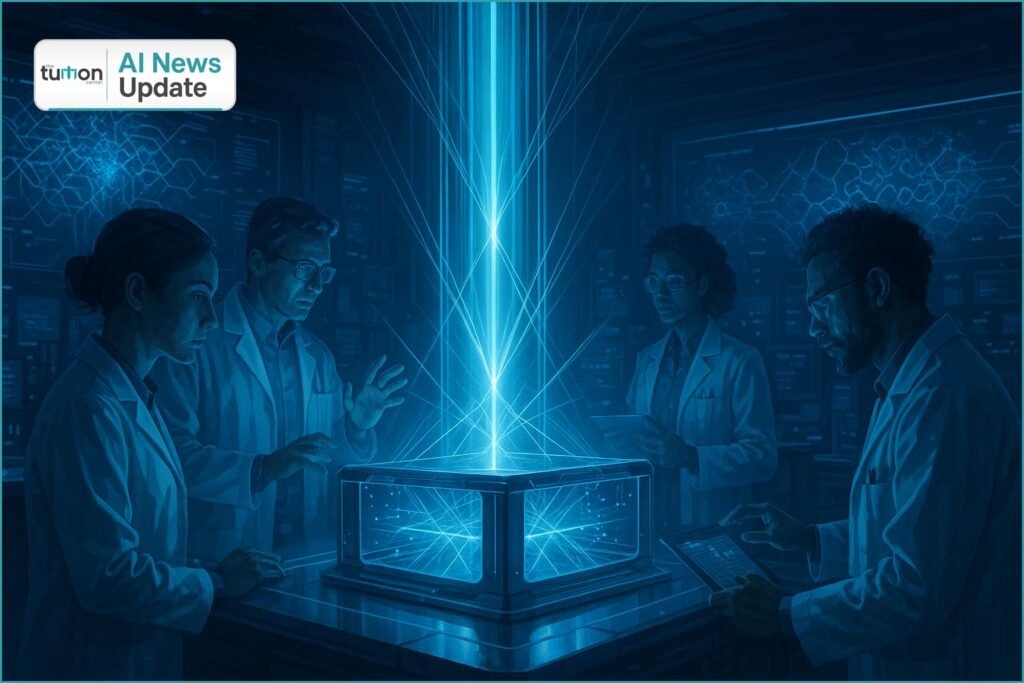
Two major breakthroughs—light-based AI hardware and a verified quantum algorithm—point to a radical shift beyond models and into new compute frontiers.
- Researchers at Tsinghua University unveiled the “Optical Feature Extraction Engine (OFE2)”, processing data at 12.5 GHz using light rather than electricity.
- Google Research announced their “Quantum Echoes” algorithm running on the “Willow” quantum processor, achieving a claimed 13,000× speed-up over classical supercomputers.
- These hardware-foundational advances signal a shift: AI will not just be about bigger models, but fundamentally different compute architectures. For education, research and industry this is the pivot point to watch.
Introduction
< landscape of artificial intelligence has been dominated in recent years by large language models, generative systems, and cloud-based compute systems. But as we hit 2025, a compelling narrative is emerging: the hardware underneath the hood matters just as much as the software on top. Two landmark breakthroughs — one in optical computing and the other in quantum algorithms — signal that the next wave of AI will be structurally different. For learners, educators and professionals at The Tuition Center, that shift means rethinking not only “how to build models” but “how to build systems”. The future we prepare for is not just algorithmic—it is infrastructural. “`
Key Developments
Optical Computing Breakthrough: The OFE2 Engine. In late October 2025, researchers at Tsinghua University published details of their Optical Feature Extraction Engine (OFE2) — a computing engine that uses light (photons) instead of electricity (electrons) to perform data-processing tasks at speeds of 12.5 GHz, combining diffraction modules and data-preparation units in an integrated optical chip. The tests showed lower latency, higher throughput and significantly reduced power consumption compared with conventional electronic architectures — especially promising for high-throughput inference, imaging pipelines, and real-time AI tasks.
Some key metrics: the optical processor was shown to handle complex imaging tasks (including hyperspectral data) and trading-simulation workloads with improved accuracy and speed. Although still experimental and in the lab, the implications are clear: if widely commercialised, such optical compute engines could reduce the cost and footprint of AI-hardware, enable new use-cases (e.g., edge AI in harsh environments, high-speed scientific detection) and open new markets (optical-AI hardware for developing countries, specialised science labs). The researchers emphasized that this is not simply “faster electronics” but a paradigm-shift in how compute is organised (photonic network, diffraction logic, data-routing via light).
Quantum Computing Breakthrough: Quantum Echoes Algorithm. At the same time, Google Research published a major milestone: their “Quantum Echoes” algorithm, running on the Willow quantum processor, achieved a speed-up of ~13,000× over the best classical supercomputer benchmarks.What makes this especially significant is not just the speed-up, but the fact that results are verifiable on independent quantum hardware — something that earlier “quantum advantage” claims often lacked. The implication: we’re closer to quantum-accelerated AI tasks (e.g., molecular simulations, materials design, combinatorial optimisation) than previously thought.
Google frames this as “accelerating the magic cycle” — where real-world challenge (e.g., drug-discovery) drives research, which then produces new tools, which are applied back to real world. The result: a research front where AI models, optical processors and quantum hardware converge.
Impact on Industries and Society
What do these developments mean practically? For industry: the advent of optical compute means that high-speed AI inference could move from large cloud data-centres into edge devices (autonomous vehicles, industrial robots, smart sensors) with far lower energy and latency. Optical engines reduce cooling, footprint and cost. That matters especially in markets like India, where energy cost, climate and infrastructure constraints are real.
For research and education: the quantum milestones open new possibilities in simulation, modelling and scientific discovery. In healthcare, materials science, climate modelling and more, AI paired with quantum/optical hardware could accelerate breakthroughs. Students and educators must be ready: the curriculum of the future will include photonics, quantum-AI, specialised hardware, not just “build a deep-learning model”.
For society: we’re seeing a shift in the AI value-chain—from software-only to hardware-plus-software. Nations investing in new compute paradigms (optical, quantum, neuromorphic) could leapfrog older players. For India and emerging markets, this opens a dual path: adopt large-scale cloud AI while also investing in indigenous hardware innovation (which may capture future value rather than purely consume). The ripple: jobs will move not only in model-tuning and prompt-engineering but in hardware system design, photonics engineering, quantum algorithm design—roles that span STEM, material science, hardware architecture, AI ethics and systems integration.
Expert Insights
“Our latest research breakthroughs show that compute architectures matter just as much as model size or data—if we don’t change the hardware, we’ll hit diminishing returns on scaling.” — Yossi Matias, Vice-President of Google Research.
“When you can process data at light-speed, the notion of AI as waiting for outputs disappears—the system becomes real-time, embedded and always-on.” — Research team at Tsinghua University on the OFE2 project.
India & Global Angle
In India, these hardware breakthroughs carry compelling implications. India’s ambition to become an AI-superpower (via the Digital India initiative, the National Strategy for Artificial Intelligence 2.0, and semiconductor-manufacturing push) means that the country is well-positioned to engage not just as a software service provider, but potentially as a hardware innovation hub. By linking academic institutes (IITs, IISc) and industry (semiconductor fabs, start-ups) to the emerging optical/quantum-AI field, India could capture upstream value rather than remain only downstream.
Globally, the hardware race is heating. With optical and quantum engines, the locus of innovation may shift beyond the classic Silicon Valley–China model, opening opportunities in Europe, Middle East, Southeast Asia and India. For example, optical-AI hardware could enable edge-AI services in remote/energy-constrained regions—opening new business models in emerging markets. Researchers, startups and educators globally whom we work with at The Tuition Center need to internalise this broader horizon: model-design is necessary but not sufficient — system-design, hardware-integration, sustainability, localisation become new battlegrounds.
Policy, Research, and Education
From a policy perspective: governments must now consider “compute sovereignty” — having access not just to AI models, but to the hardware and infrastructure that powers them. For strategic sectors like defence, healthcare, energy and education this becomes a national imperative. Funding programmes should expand beyond model-training grants to hardware ASICs, photonic chips, quantum research labs and paired curriculum.
In research: foundational work will expand in quantum-AI, photonic-AI, neuromorphic computing and hybrid compute architectures. The interplay of algorithm, hardware and system-integration will become a core research theme rather than specialty. For educators, learning modules should evolve to include hardware awareness: photonics, quantum mechanics, hybrid‐AI systems design, sustainability of compute, hardware ethics (e-waste, energy use) and frontier materials science.
Challenges & Ethical Concerns
These breakthroughs are immensely promising—but also raise major questions. First, access and equity: if optical-AI and quantum-AI become competitive advantages, will only resource-rich institutions or nations access them, widening divides? Second, sustainability: while optical engines promise lower power per operation, new materials, specialised manufacturing and disposal may introduce new environmental burdens. Third, oversight & verification: quantum algorithms and novel hardware often lack interpretability; ensuring reliability, transparency and auditability when hardware itself is novel becomes harder. Fourth, circular economy and hardware lifecycle: hardware advances could accelerate obsolescence, making disposables and e-waste a growing concern.
Future Outlook (3–5 Years)
- Optical computing modules begin to be embedded in commercial AI hardware stacks—edge-AI devices, high-frequency trading, scientific instruments, remote sensing will be early adopters.
- Quantum algorithms like Quantum Echoes will move from lab-proof to hybrid classical/quantum pipelines in real-world domains (materials design, drug-discovery, climate modelling) with early commercial use-cases by 2028.
- Hardware-aware AI education becomes mainstream: courses will introduce students not only to models and code, but to photonic logic, quantum circuits, co-design of hardware + algorithm, sustainable compute systems.
- Regions that invest early in compute sovereignty will emerge as new AI-hardware hubs rather than just service centres. India, Southeast Asia, Middle East may capture part of this wave if local ecosystems align now.
- The notion of “scaling by more data + larger models” will give way to “scaling by smarter hardware + more efficient compute” — meaning the cost-curve of AI will change shape, making previously niche applications viable globally.
Conclusion
For students, professionals and educators at The Tuition Center: the era of AI is evolving from “build a bigger model” to “build a smarter system”. The breakthroughs in optical computing and quantum-AI hardware invite you to expand your lens: learn not just how to prompt a model, but how to integrate AI into novel infrastructures, how to collaborate with multidisciplinary teams (hardware engineers, physicists, software developers), and how to think about longevity, sustainability and global impact of AI systems. This is your opportunity—not just to ride the AI wave, but to help shape the next wave. Build curiosity. Build systems knowledge. Build for a future where AI is embedded in the very fabric of our infrastructure—and you will be ahead.
“`
Great! Here’s **Story #5 – “AI in Business, Jobs & Economy”** for **The Tuition Center (AI Update)**.