
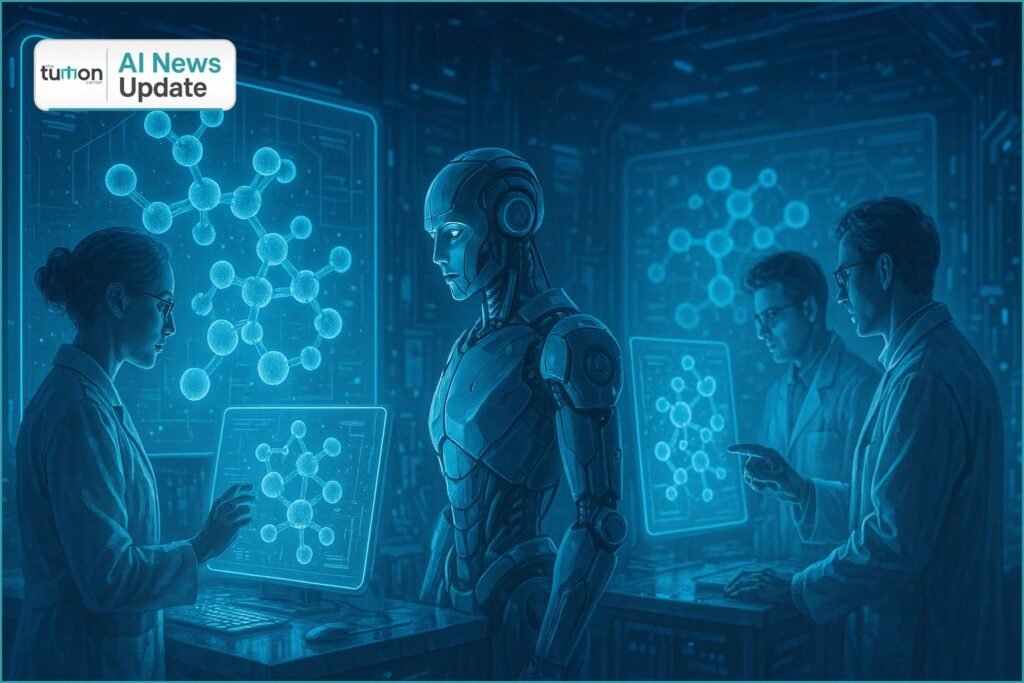
Researchers deploy generative-models with design-rules to propose quantum-materials, signalling a new frontier in AI research and application.
- A tool called SCIGEN from MIT enables AI models to generate materials that meet user-specified design rules.
- This approach helps overcome a longstanding bottleneck in quantum-materials discovery.
- It foreshadows a future where generative-AI touches chemistry, physics, materials, and science at scale, not just text/image. Introduction
Key Developments
Materials science, especially in the quantum domain (superconductors, quantum-spin liquids, advanced magnets), has historically been slow: decades of research yield a small number of candidate materials. The bottleneck: large search spaces, costly synthesises, long trial cycles. Enter SCIGEN: the MIT team noted that conventional generative-AI models tended to optimise general criteria (stability, low cost) and missed the structural peculiarities that make quantum materials interesting.
The innovation of SCIGEN: instead of “generate many possibilities”, the system allows researchers to input **design rules** — for example geometric patterns, element combinations, spatial constraints — and the generative-model must adhere to them. The output is a set of material-candidates that follow the rules, narrowing the search space and increasing the likelihood of novelty.
Importantly, the researchers emphasise that while SCIGEN proposes candidates, experimental validation is still essential. The AI model does not replace lab-work; instead it accelerates the ideation and simulation phase, meaning scientists spend less time on unfruitful directions.
Impact on Industries and Society
In **industry**, new materials can drive leaps: more efficient batteries, advanced cooling systems, quantum-computing devices, next-gen sensors, and clean-tech innovations. If SCIGEN or similar tools reduce discovery time, companies could gain competitive edge in technology cycles, sustainable innovation, and cost-efficiency.
For **education**, the implication is that science curricula must adapt. Teaching just the fundamentals of physics or chemistry is no longer enough; students must learn how to harness AI-models, understand constraints, evaluate outputs, and connect with lab work. Multi-disciplinary is the word: AI + domain knowledge + experimental design.
Expert Insights
“The models from these large companies generate materials optimized for stability … Our perspective is that’s not usually how materials science advances.” — Professor Mingda Li, MIT.
The quote underlines the shift in generative-AI: it’s not just about optimizing for stability or general metrics, but aligning with domain-specific goals and human insight. That’s a critical lesson for all AI learners: aligning AI with purpose is what counts.
India & Global Angle
India has strong ongoing efforts in materials research (energy storage, carbon-capture, advanced electronics) and an expanding AI ecosystem. By embracing platforms like SCIGEN (or building indigenous equivalents) India can take a seat at the table of global innovation rather than being a downstream participant. Encouraging collaborations between AI-labs, materials-labs and industry will be key.
Policy, Research & Education
Policy-makers should consider supporting “AI + Science” programmes — funding not just model-development but disciplined application in domains like materials, chemistry, biology, environmental science. Research centres should build cross-discipline teams (AI engineers + materials scientists + chemists). Education must incorporate “AI for scientific discovery” modules, project-based learning, and real-world labs where students use AI-tools to propose, simulate and eventually test new materials.
Challenges & Ethical Concerns
Despite its promise, SCIGEN raises several concerns. One: the materials being proposed may pose environmental or safety risks if deployed without full testing. Two: the “black-box” nature of generative-AI raises transparency issues in science: can we trace why a candidate was proposed? Three: access — if only elite labs have access to such tools, global inequality widens. Finally: educational equity — will students globally have access to this frontier? We must ensure democratization remains a priority.
Future Outlook (3-5 Years)
- Generative-AI tools will proliferate in domain-specific fields: biology (protein design), chemistry (catalysts), materials (superconductors), agriculture (crop genetics).
- Discovery cycles will shorten: ideation → simulation → candidate → lab-synthesis → commercialisation, all in months rather than years.
- Education and research programmes will evolve: “AI-augmented scientist” will become a recognized role, blending machine-fluency with domain-expertise.
Conclusion
SCIGEN is more than a research tool — it’s a beacon of what’s possible when AI moves from augmentation to design. For students, professionals and educators, the lesson is clear: build your skills where AI meets domain-expertise. Whether you’re in engineering, physics, chemistry, or simply curious about innovation — now is the time to engage with how AI can become a partner in discovery, not just a tool. The frontier is open — go explore, create, impact.