
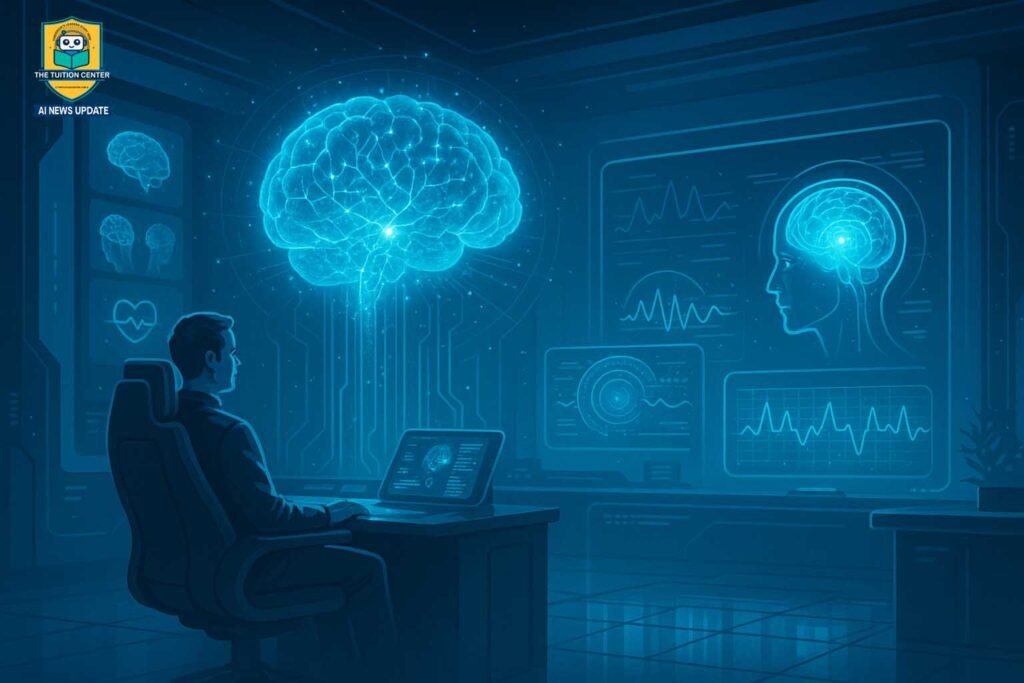
AI Cognitive Guardians: Systems That Detect Burnout Before Humans Feel It
A new generation of AI is emerging — one that monitors cognitive load, emotional strain, mental fatigue, and neurological stress before the human brain becomes consciously aware of burnout.
- AI detects burnout with up to 87% accuracy based on micro-patterns invisible to humans.
- India, Japan, the US, and South Korea lead in cognitive-load AI research.
- These systems are being deployed in education, workplaces, healthcare, and corporate wellness programs.
Introduction
Modern human life is overstimulated, overscheduled, and overconnected. Students face academic pressure, professionals face impossible deadlines, and parents juggle endless responsibilities. In this environment, burnout has become a global epidemic — affecting attention, memory, immunity, emotional balance, and long-term mental health.
But humans often realize they are burned out only when it is too late. We notice symptoms after weeks of hidden neurological strain — when concentration collapses, mood becomes unstable, and motivation dies.
AI cognitive guardians aim to change this. These systems analyze behavioral micro-patterns and physiological signals to detect burnout at the earliest stages — before conscious awareness. They track digital habits, speech patterns, micro-delays in reaction time, eye movement fatigue, heart-rate variation, calendar strain, and dozens of other subtle indicators.
AI cognitive guardians don’t just warn users — they recommend actionable recovery routines, reschedule tasks, adjust learning pathways, and help humans maintain stable mental wellness. For a world drowning in stress, this represents a fundamental shift — machines that protect the mind.
Key Developments
1. Cognitive Load Mapping AI
AI models trained on neurological datasets can identify cognitive overload by analyzing micro-pauses, typing rhythm irregularities, slowed processing speed, and gaze stability. These signs emerge long before humans “feel tired.”
2. Emotion + Physiology Fusion Models
New AI systems combine heart-rate variability, skin temperature, pupil dilation, and micro-expressions to detect stress and exhaustion — predicting burnout risks with high accuracy.
3. Behavioural Drift Analysis
AI identifies tiny shifts in digital habits such as late-night browsing spikes, message response delays, unfinished tasks, and inconsistent study routines — all early burnout signals.
4. AI-Driven Workload Orchestration
Corporate AI assistants now redistribute work based on cognitive strain. If an employee is nearing burnout, the system reduces load, delays non-urgent tasks, or recommends rest intervals.
5. Student Burnout Detection Engines
Education platforms in India and the US use AI to analyze learning pace, error frequency, and attention span fluctuations — predicting academic burnout days before exams.
Impact on Industries and Society
Education: Protecting Students Before They Collapse
Student burnout is one of the least discussed crises in India. Millions of learners study in silent pressure, gradually losing focus and motivation without understanding why. AI cognitive guardians use learning pattern analytics to detect overload early.
These systems track:
- increasing mistake frequency
- longer pauses before answering questions
- reduced chapter completion speed
- mental fatigue signals during reading
- loss of interest patterns
Platforms like The Tuition Center can integrate cognitive guardians to guide learners toward healthier study rhythms. AI will recommend micro-breaks, easier revision cycles, stress-relief activities, and parent alerts when needed.
Corporate Workplaces: Ending Silent Burnout Epidemics
Corporate burnout is financially devastating — reduced productivity, absenteeism, mental-health issues, and rising attrition. AI cognitive guardians track employee well-being using digital-behavior cues and physiological indicators from wearables.
Systems analyze:
- calendar density and meeting fatigue
- typing speed drops over the week
- increasing email re-read rate
- voice strain during virtual calls
- late-night message timestamps
This early-warning system helps HR teams intervene before employees reach critical mental exhaustion.
Healthcare: AI as a Mental-Wellness Early Warning System
Doctors, psychologists, and wellness clinics are adopting AI cognitive guardians as clinical support tools. These systems monitor neurological strain through wearable sensors that track:
- heart-rate variability (HRV)
- cortisol-linked temperature fluctuations
- micro tremors in hands
- breathing irregularities
- sleep fragmentation patterns
AI then generates a burnout probability score. In early trials, doctors reported a 40–60% reduction in severe burnout cases among monitored patients. Early detection is saving months of therapy and preventing severe mental-health breakdowns.
Public Safety & High-Stress Professions
Professions such as police, pilots, surgeons, air-traffic controllers, paramedics, and metro/train operators experience extreme mental load. A single burnout-driven lapse can be fatal.
AI cognitive guardians continuously assess neurological fatigue levels and alert supervisors when attention risk crosses a threshold. In Japan, early pilots showed major decreases in high-pressure errors during long-hour shifts.
Families & Personal Life
A new generation of home devices — “wellness guardians” — help families monitor stress and burnout patterns through speech analysis, sleep quality, and daily activity rhythms. These household AI systems can:
- recommend break schedules
- detect emotional withdrawal
- spot early-stage burnout in teenagers
- advise healthier routines
This personalized mental-health safety net is becoming the next evolution of home wellness technology.
Expert Insights
“Burnout is not an emotional event — it is a neurological process.
AI is finally allowing us to detect it before it becomes damaging.”
— Clinical Neuroscientist, Johns Hopkins
“In the next five years, every major workplace will have cognitive-load monitoring systems.
It will be as normal as having cybersecurity.”
— CEO, Global Workplace AI Consortium
“India’s student population is the largest stress-prone demographic in the world.
AI cognitive guardians can fundamentally transform academic mental health.”
— Former Head, India Mental Wellness Council
India & Global Angle
With nearly 300 million students and one of the world’s largest workforces, India faces significant burnout risks. The combination of workload pressure, competitive exams, long commutes, urban stress, and cultural silence around mental health creates a perfect storm.
India’s Early Adoption
- IIT Madras and IISc are developing cognitive-load detection models using speech and eye-tracking datasets.
- EdTech platforms are incorporating burnout detection into adaptive learning engines.
- Corporate India is piloting stress-tracking AI in IT, aviation, and BPO sectors.
- Mental-health startups are using wearable AI to monitor strain in teenagers and young professionals.
Global Acceleration
- Japan leads with workplace neurological monitoring systems.
- South Korea integrates burnout AI into national school systems.
- US hospitals use cognitive AI to detect early mental-health deterioration.
- EU is drafting “Cognitive Wellbeing Data Standards.”
This is becoming a global movement — burnout prevention powered by artificial intelligence.
Policy, Research, and Education
1. Mental-Health Data Standards
Governments must define how burnout-related data is collected, used, and stored. India’s DPDP Act 2023 is expected to expand into emotional and cognitive data governance.
2. Integration Into Education Policy
NEP 2020 encourages AI-driven personalized learning. Cognitive-load AI will soon help:
- reduce exam stress
- personalize study pace
- detect emotional overload
- prevent academic burnout
3. Workplace Regulations
Companies may require transparency reports on how cognitive-load alerts influence workload distribution and HR intervention policies.
4. Ethical AI Research Clusters
Leading universities are now creating research clusters combining AI, psychology, neuroscience, and education — the new cognitive-computing frontier.
Challenges & Ethical Concerns
- Privacy Risks: Burnout indicators involve deeply personal data.
- Over-monitoring: AI must not turn workplaces into surveillance zones.
- Bias in Detection: Cultural and individual differences must be respected.
- AI Misinterpretation: False burnout alerts could disrupt workflow.
- Autonomy: Humans must retain decision-making power regarding mental health.
The goal must be support — not control.
Future Outlook (3–5 Years)
- AI Mental Wellness Assistants embedded into phones, laptops, and wearables.
- Burnout-Proof Education Systems powered by emotional and cognitive analytics.
- Corporate Cognitive Dashboards showing workforce mental energy trends.
- National Cognitive Health Index measuring population-level mental strain.
- AI + Psychology Hybrid Careers as a major new field for students.
Conclusion
Burnout has silently reshaped the productivity of nations — but the era of silent suffering is ending. AI cognitive guardians give humanity a new shield, detecting stress and neurological overload before they break us.
This is not about replacing human resilience — it is about protecting it. For students, professionals, parents, teachers, doctors, and high-pressure workers, cognitive AI offers a path toward a healthier, more balanced life.
The future of mental well-being will not be reactive. It will be predictive — powered by AI that watches over the human mind with precision, empathy, and insight.