
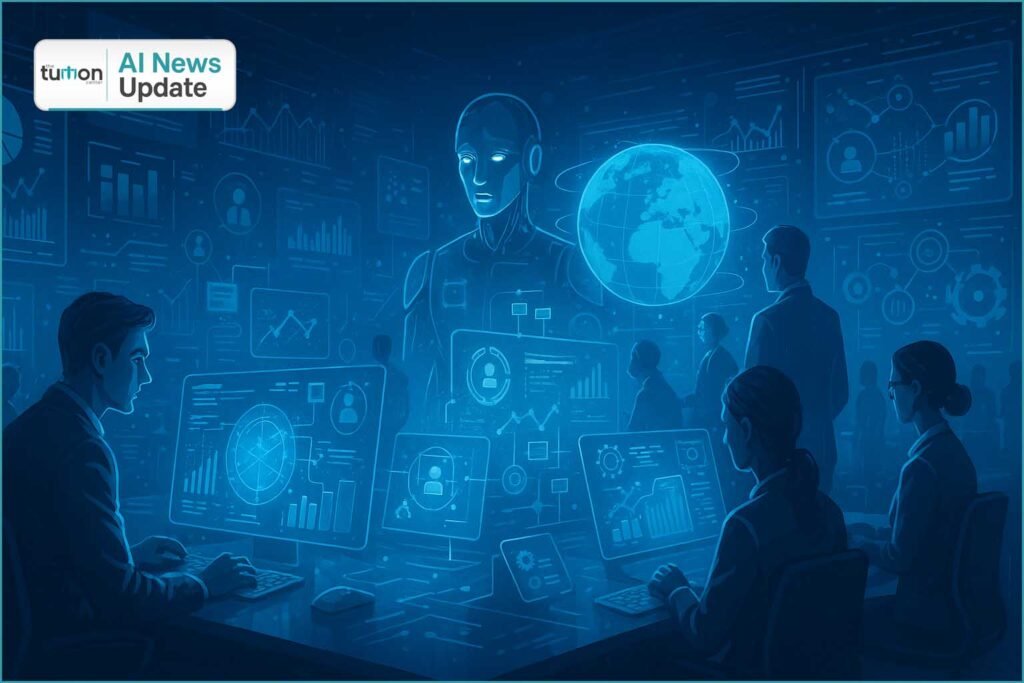
A worldwide alliance of AI labs, universities, and governments is reshaping innovation at unprecedented speed — making 2025 the strongest year yet for AI R&D growth.
- Over 2,400 new AI research labs were founded worldwide since 2023.
- India, the US, South Korea, Japan, and the EU are leading the global AI-R&D race.
- Cross-border collaborations grew by 68% in 2025, the highest in a decade.
Introduction
Research is no longer confined to geography. The year 2025 marks the first time in history where the majority of AI breakthroughs are coming from global, multi-institution collaborations — not isolated labs. From deep-learning architectures to quantum-AI simulators, from AGI-safety clusters to climate-modeling supercomputers, the global research ecosystem has accelerated to a pace that even the world’s top scientists describe as “beyond linear growth.”
What changed? Three things: faster GPUs, maturing GenAI models, and the rise of open research ecosystems. Universities, startups, governments, and private labs are now sharing models, datasets, safety protocols, and evaluation frameworks. The goal is no longer competition — it is collective advancement. And the result is a level of discovery that feels like stepping into the next decade ahead of time.
Key Developments
The AI research world has exploded into clusters of innovation: AGI safety labs, medical-AI labs, autonomous robotics hubs, EdTech-AI clusters, and national AI mission centers. In 2025, more than 2,400 new labs were launched — many linked through global programs. India’s Bharat AI Mission, South Korea’s Neuromorphic Initiative, Japan’s Robotics 2040 Plan, and the EU’s Trustworthy AI Act significantly boosted public research funding.
Industry partnerships saw record expansion. Google DeepMind expanded collaborations with 60+ universities. OpenAI partnered with multiple national education systems. India’s IIT-AI Consortium entered joint research with MIT, ETH Zurich, and NUS Singapore. Korean semiconductor AI labs formed alliances with Dutch and Taiwanese chip researchers.
The shift is clear: the biggest breakthroughs are emerging when nations pool expertise rather than keeping research closed.
Impact on Industries and Society
The societal effects are enormous. Medicine is witnessing AI models that diagnose cancers months earlier. Climate scientists are building AI systems predicting extreme weather with higher accuracy. Educators are using AI labs to generate personalised learning pathways for over 1.5 billion students. Startups are leveraging AI-research insights to prototype robotic systems, fintech fraud detection engines, and cybersecurity shields.
Industries now treat AI labs not as R&D units but as strategic partners. Automobile companies rely on AI labs for autonomous systems. Governments look to AGI-safety groups for ethical frameworks. Hospitals pilot AI radiology models co-developed with universities. The research output is no longer whitepapers — it is real-world change affecting billions of lives.
Expert Insights
“The defining feature of 2025 is the collapse of research silos. Everyone is building together — and that’s why progress looks exponential.” — Dr. Lena Moritz, European AI Council.
“India’s AI labs are now contributing at global scale. The talent pool here is unmatched — this decade belongs to collaborative innovation.” — Prof. Arvind Rao, IIT Madras AI Research Center.
“AI research has moved from curiosity to infrastructure. It is now a national capability like electricity or space programs.” — Dr. Naomi Klein, Stanford Human-Centric AI Institute.
India & Global Angle
India’s rise in global AI research is one of the most important shifts of this decade. With IITs, IISc, IIITs, and private R&D labs contributing to language models, healthcare AI, and chip research, the country has positioned itself as an AI innovation powerhouse. Bharat GPT, Indic LLMs, and National AI Missions are strengthening India’s role in multilingual AI research — an area where Western labs lack native expertise.
Globally, the US still leads foundational model R&D. The EU dominates AI ethics and regulatory frameworks. China leads scale and deployment. South Korea and Taiwan lead semiconductor R&D. Japan leads robotics. UAE leads AI-in-governance. Australia leads climate-AI modeling.
Together, they form a global lattice of research capabilities — and the joint output is transforming the entire AI landscape.
Policy, Research, and Education
Governments are rethinking how regulation and innovation coexist. New policies encourage:
- Open-source LLMs with audited safety layers
- AI-ethics guidelines for schools and universities
- National AI Research Fellowships
- AI-ready curriculum for grades 6–12
- Cross-border AI researcher mobility programs
Education is undergoing a parallel transformation. Universities are introducing AI-first courses in data science, robotics, generative modelling, AI law, explainable AI, and human-centered computing. Six-month micro-degrees are replacing long theoretical programs.
AI is no longer optional — it is the foundation of all modern learning streams.
Challenges & Ethical Concerns
Rapid growth brings risks: data privacy breaches, model hallucination, unequal research funding, bias propagation, and talent concentration in a few countries. There is also concern about “AI monoculture” — where global models begin shaping cultural narratives.
Researchers stress the need for:
- diverse datasets, especially from the Global South
- audited training pipelines
- transparent model evaluations
- open access safety benchmarks
- strong AI-for-good commitments
The world must balance innovation with responsibility — or risk unsupervised acceleration.
Future Outlook (3–5 Years)
- AI labs will shift toward super-aligned models and human-centric intelligence.
- Cross-border research “clusters” will become standard — like global space missions.
- AI will become embedded infrastructure in healthcare, governance, and defence.
Conclusion
The 2025 global AI research boom is not just a technological milestone — it is a turning point for human knowledge. For the first time, humanity is building intelligence collectively. Students, researchers, startups, nations — all contribute to a global AI ecosystem moving faster than any innovation wave before it. For learners and professionals, this is the decade to step forward, skill up, and become part of the research-driven future.