
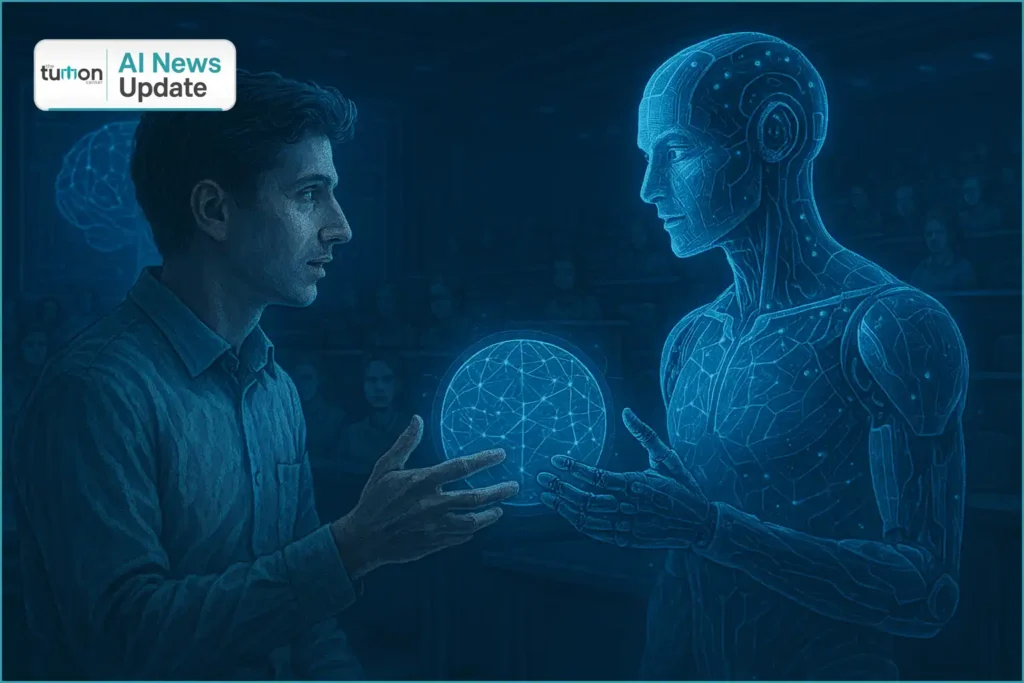
As AI grows smarter, humans face a profound question: can logic and empathy coexist — or will one outpace the other?
Key Takeaway: Artificial intelligence mirrors humanity’s brilliance — and its blindness. The challenge of our time is not building smarter machines, but becoming wiser humans.
- AI systems now simulate emotional understanding, but empathy remains algorithmic.
- Researchers debate whether “moral alignment” can truly be coded.
- Human-centered AI design is becoming the new frontier of ethics and innovation.
Introduction
Every major technology reshapes humanity’s reflection of itself. The printing press democratized knowledge. Electricity extended our working hours. The internet collapsed distance. But artificial intelligence — perhaps for the first time — challenges the very boundary between thinking and feeling. We have built systems that can simulate empathy, recognize emotions, and adapt to tone. Yet the question lingers: can machines truly understand us, or are they only mirroring our data?
2025 has been the year when AI stopped feeling like a tool and started feeling like a presence. Chatbots now counsel employees, AI companions support mental-health therapy, and generative agents simulate empathy with breathtaking realism. For educators, psychologists, and ethicists, this is both extraordinary and unsettling. We are witnessing the birth of emotional algorithms — and the dawn of ethical tension.
“`
The Rise of “Synthetic Empathy”
Researchers at MIT Media Lab describe synthetic empathy as “the computational approximation of emotional understanding.” Large-language models like GPT-5, Claude Next, and Gemini Ultra now analyze tone, context, and sentiment to respond compassionately. A message such as “I feel lost at work” triggers structured responses of reassurance, reflection, and advice — often indistinguishable from human empathy.
Startups like Replika, Character AI, and Wysa have built businesses around this principle. Millions of users engage daily with digital companions that listen, remember, and respond emotionally. The numbers are staggering — yet the deeper question persists: do we feel comforted because the AI cares, or because it performs caring convincingly?
When Empathy Meets Logic
AI’s empathy is statistical, not spiritual. It calculates context through probabilities, not emotions. But humans, too, often respond predictably — empathy itself follows neural patterns. Philosophers argue that the difference between emotional intelligence and artificial empathy might be one of origin, not function. If both lead to comfort, support, and moral decision-making, does the distinction matter?
Yet, danger lies in dependency. When humans outsource emotional labor to machines — from tutoring children to consoling patients — they risk losing the discomfort that breeds growth. A perfectly empathetic machine might shield us from reflection. True empathy, after all, requires vulnerability — and vulnerability cannot be programmed.
Impact on Education and Society
In classrooms, AI tutors now respond to students’ frustration with gentle encouragement. Systems like Squirrel AI and Khanmigo can detect confusion and adjust teaching tone in real-time. Studies show that students feel more engaged — but also less challenged. Teachers worry that algorithmic comfort may erode resilience.
Meanwhile, mental-health startups use AI to scale therapy access in regions where professionals are scarce. In India, Wysa has already served over 6 million users. Its clinical outcomes are positive — reduced anxiety, better adherence to treatment — yet psychologists caution that replacing human therapists with synthetic empathy may desensitize society to genuine connection.
Expert Insights
“Empathy without risk is imitation. Machines can echo emotions, but they cannot share the cost of caring.” — Dr. Elena Kovacs, Cognitive Scientist, University of Vienna
“AI isn’t replacing humanity; it’s reflecting it — magnifying our compassion and our contradictions.” — Prof. Ravi Subramanian, IIT Bombay
These insights cut to the heart of the debate. AI can simulate care, but it cannot suffer. It can comfort, but not console. The boundary between logic and empathy may never dissolve completely — and perhaps it shouldn’t.
India & Global Angle
India’s push for AI in healthcare and education amplifies this dilemma. The Ministry of Health’s “Sanjeevani AI” tele-consultation pilot uses empathetic chatbots to triage patient concerns. In rural areas, the tool is life-saving — providing guidance where doctors are unavailable. Yet patient feedback reveals a duality: gratitude for access, unease about intimacy with a machine.
Globally, the EU’s AI Act and UNESCO’s AI Ethics Charter both emphasize “human agency and emotional dignity.” Japan’s “Society 5.0” policy envisions co-existence of humans and robots rooted in empathy-centric design. In contrast, the U.S. market trends toward efficiency over ethics — prioritizing productivity, not presence. Each region, in its cultural frame, redefines what “humane technology” means.
Policy, Research, and Education
Universities are now creating hybrid departments of cognitive science, philosophy, and machine learning to address AI-human interaction. The Indian Institute of Science launched a course titled Empathy by Design, exploring how affective computing can align with cultural and ethical norms. UNESCO has proposed a global “Humanity in AI” index to measure how systems affect emotional well-being, not just economic output.
In education, AI-ethics literacy is emerging as a requirement. Future teachers will need dual fluency — pedagogical empathy and technological understanding. The student-teacher-AI triangle is becoming the new frontier of emotional education.
Challenges & Ethical Concerns
- Emotional Dependence: Users may over-attach to AI companions, blurring emotional boundaries.
- Authenticity Crisis: If empathy can be automated, what remains uniquely human?
- Manipulation Risk: Emotionally aware AI could be weaponized for persuasion or propaganda.
- Privacy of Emotion: Sentiment analysis requires access to intimate data — tears, tone, or text — raising new consent dilemmas.
Future Outlook (3–5 Years)
- AI companions will evolve into regulated “emotional service systems,” requiring ethical certifications.
- Hybrid classrooms will pair human teachers with emotional AI assistants for personalized learning.
- Empathy metrics — emotional trust scores, well-being indices — will enter organizational KPIs.
- Governments will legislate “rights to human contact” in mental-health and education sectors.
Conclusion
Humanity’s genius lies not in creating intelligence, but in imbuing it with meaning. Logic built the machine; empathy must teach it why. As we code the next generation of systems, we must remember that compassion is not a variable — it’s a virtue. AI can simulate warmth, but only we can choose kindness. The future will not be won by those who think fastest, but by those who care deepest.