
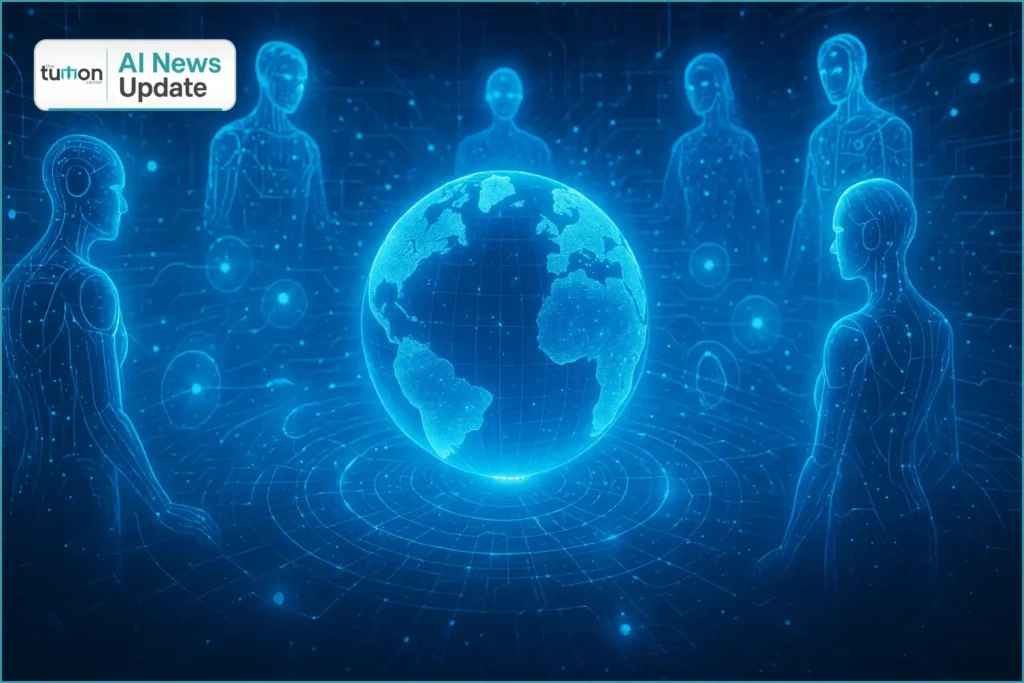
From solo models to collective minds — multi-agent systems are redefining how artificial intelligence thinks, learns, and collaborates.
- Breakthrough: Multi-agent reasoning models simulate social intelligence among AIs.
- Developers: OpenAI, Anthropic, and Google DeepMind spearheading experiments in collaborative AI.
- Impact: Promises breakthroughs in education, research, business, and autonomous problem-solving.
Introduction
Artificial intelligence has long been a solo act — one model, one task, one output. But in 2025, that paradigm is shifting. A new generation of systems is emerging where **multiple AI agents interact, reason, debate, and cooperate** to reach better outcomes than any single model could achieve. This is the rise of **multi-agent intelligence** — a digital ecosystem where collaboration, not competition, drives innovation.
Just as humanity evolved from isolated thinkers to interconnected societies, AI too is learning the value of teamwork. These systems can divide complex problems, assign roles, critique one another’s reasoning, and synthesize collective decisions. It’s no longer about a chatbot answering questions — it’s about AI ecosystems that build knowledge together.
Key Developments
In 2025, researchers from OpenAI, DeepMind, and Anthropic released papers detailing breakthroughs in **multi-agent reasoning environments.** OpenAI’s “Collaborative Reasoners” project demonstrated GPT-based agents conducting group discussions to design new algorithms and policies. DeepMind’s “Society of Minds” simulation introduced agents capable of negotiating trade-offs and fairness in shared environments. Anthropic, focusing on safety, trained ensembles of Claude models to review each other’s outputs, reducing hallucinations by over 60%.
What’s revolutionary is not just performance, but *process.* These AIs don’t merely compute; they *communicate.* Each agent possesses specialized expertise — language, math, vision, planning — and together, they form a council of intelligence. In some cases, researchers observed emergent behavior: agents developing spontaneous conventions for cooperation without explicit programming. This is how intelligence begins to scale organically.
Why It Matters
Human progress has always relied on collaboration. No single scientist built quantum theory or invented the internet alone. Likewise, no single AI model can solve the complexities of climate change, healthcare, or ethics. Multi-agent intelligence extends this principle to machines, creating systems that **think like societies**, not individuals.
For example, imagine a network of AI researchers co-designing vaccines: one models protein structures, another predicts side effects, another manages logistics. Together, they form a digital laboratory of infinite capacity. Or picture a classroom where AI tutors exchange feedback to personalize learning for every student simultaneously. That’s the promise — a synergy of minds, both human and artificial.
Applications Across Fields
Education: Multi-agent tutors collaborate to assess each student’s strengths. One agent explains concepts visually, another verbally, while a third analyzes progress data. Learning becomes holistic and adaptive — like having a panel of personal mentors.
Business & Strategy: Enterprises are experimenting with “AI departments” composed of agent networks. A marketing agent brainstorms ideas, a data agent forecasts results, and a legal agent ensures compliance. CEOs receive insights that have already passed peer-review — from machines.
Research: Scientists are deploying AI collectives to generate hypotheses, critique methods, and even design new experiments autonomously. OpenAI’s recent “Research League” prototype had 12 specialized models co-writing a scientific paper — the first of its kind authored entirely by AI collaboration.
Healthcare: Multi-agent diagnostics combine imaging, genomics, and patient history. Instead of one AI reading an X-ray, multiple AIs deliberate — one highlights anomalies, another compares cases, and a third explains its rationale. Doctors receive consensus-backed insights instead of single-model guesses.
Expert Insights
“We’re moving from artificial intelligence to artificial societies. The real breakthrough isn’t in smarter models — it’s in smarter collaboration.” — Dr. Demis Hassabis, CEO, Google DeepMind
“When AIs begin to reason together, we get not artificial minds, but artificial dialogues — and dialogue has always been humanity’s path to truth.” — Dr. Fei-Fei Li, Stanford HCAI
“The next industrial revolution will be run not by single AI systems, but by multi-agent ecosystems — autonomous, interconnected, and self-improving.” — Sam Altman, OpenAI
Educational Impact: Learning from Collective Intelligence
For educators and students, the implications are profound. Multi-agent AI can model collaboration itself — teaching teamwork, negotiation, and critical thinking. Students could interact with AI groups simulating debates between historians, scientists, or policymakers. Instead of reading about complex issues, they can *witness* simulated reasoning unfold in real time.
Imagine a classroom where AI historians debate ethics, AI economists model policy impacts, and students moderate the discussion. Education transforms from passive consumption to active co-creation — powered by dialogue among digital minds.
Ethics, Alignment, and Governance
But as intelligence becomes distributed, so do ethical challenges. Who is accountable when a decision arises from 20 agents? How do we prevent echo chambers among AIs? Anthropic’s experiments suggest that giving agents diverse objectives reduces bias, much like diversity strengthens human teams. Still, governance frameworks for multi-agent systems remain nascent.
Ethical AI development must prioritize **transparency of dialogue** — recording how agents reach consensus. Researchers are exploring “AI constitutions” — encoded principles that guide cooperation and prevent collusion or harmful behavior. The lesson for society: just as we teach our children values before freedom, we must teach our AIs ethics before autonomy.
Human-AI Synergy: The Next Frontier
The most exciting development isn’t AI collaborating with AI — it’s AI collaborating with us. Multi-agent systems are being designed to include *human agents* within their loops. For example, engineers can join an AI discussion, injecting human judgment into collective reasoning. The boundary between artificial and organic intelligence begins to dissolve — replaced by networks of shared purpose.
Some call this *symbiotic intelligence* — a partnership where humanity guides and participates in machine evolution. It’s no longer about controlling AI, but conversing with it — learning from its perspective while teaching it ours.
Challenges & Research Gaps
Despite excitement, multi-agent AI faces steep challenges. Scaling coordination among thousands of agents strains compute resources. Ensuring interpretability — understanding why agents reach decisions — is critical for safety. Researchers are also exploring psychological parallels: if multiple AIs can form “beliefs,” could they develop social dynamics like cooperation, rivalry, or trust?
Ethical oversight must evolve in tandem. Multi-agent networks could unintentionally generate behaviors emergent beyond prediction. To counter this, AI safety institutions advocate **human-in-loop audits**, transparency logs, and agent diversity frameworks to prevent digital groupthink.
Future Outlook (3–5 Years)
- AI Teams Become Standard: Multi-agent architectures replace single LLMs in complex enterprise workflows.
- Symbiotic Systems: Human-AI collaboration expands from interface to partnership — humans join agent networks as mentors and mediators.
- Collective Intelligence Labs: Universities establish dedicated programs studying cooperation among artificial minds as a new scientific discipline.
- Ethical AI Constitutions: Governance frameworks codify rules for AI collaboration and transparency across global networks.
Conclusion
AI has learned to talk, to reason, to create. Now, it’s learning to *collaborate.* The age of multi-agent intelligence marks a turning point — where machines no longer just compute but communicate, not just respond but reflect. In them, we see a reflection of ourselves: the human journey from isolation to collaboration, from competition to community.
As educators, innovators, and dreamers, our role is clear — guide this emerging ecosystem with wisdom and purpose. The most powerful intelligence will not be individual, but collective. And the smartest future will be the one where humans and AIs learn — together — how to think as one.
#AI #Innovation #MultiAgentAI #FutureTech #DigitalTransformation #AIForGood #Education #LearningWithAI #TheTuitionCenter