
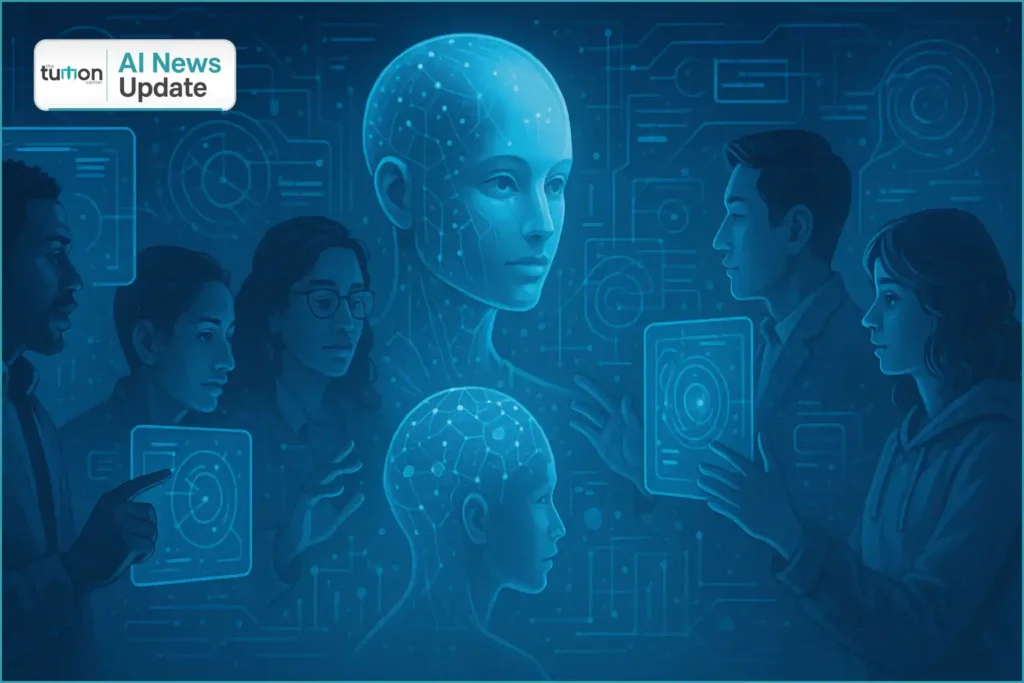
Why the real debate isn’t whether AI will replace us—but how we will design, govern and collaborate with it.
- Across sectors, AI is augmenting human capabilities, not simply automating them.
- Deep questions of design, ethics, access and power are emerging as central concerns for education and society.
- The next decade demands not only technical literacy but also human-centric thinking, adaptability and lifelong learning.
Introduction
When we speak of artificial intelligence, headlines often suggest “will robots take our jobs?”, “will machines replace teachers?”, or “will AI surpass human intelligence?”. These question frames evoke fear. But perhaps the more productive lens is: how do we live *with* AI, shape it, govern it and benefit from it as humans collaborating with machines? The shift from replacement to partnership underpins the real societal challenge—and opportunity—of AI in the coming years.
“`
Key Developments
Recent research reveals that in the short- to medium-term, AI is more likely to change *tasks* than eliminate *jobs* outright. For example, about 27 % of AI-using firms report using AI to replace tasks; meanwhile job impacts are slower to materialise.
At the same time, education and workforce trends show that workers in AI-exposed occupations are seeing **rising wages and value**, not just reductions. According to the PwC 2025 Global AI Jobs Barometer: “Contrary to fears about job losses, job numbers – and wages – are growing in virtually every AI-exposed occupation, including the most highly automatable jobs.”
On the ethical front, global events like the World AI Week emphasise inclusion and human-centred AI design. Professor Elena Gaura wrote: “When we bring our competencies together, ensure that no one is left behind and design for a future that adapts with us, AI becomes more than a tool. It becomes a shared act of imagination.” Impact on Industries and Society
In education: The narrative shifts from “let’s teach AI to students” to “let’s teach students how to partner with AI”. That means critical thinking, ethics, domain knowledge plus AI fluency. It means asking: how is AI used? Who benefits? What are trade-offs?
In healthcare, law, public policy: AI tools will increasingly become co-workers, assistants and advisors. That means professionals will need to shape AI, monitor it and govern it—not only deploy it. This demands new literacy, governance frameworks and hybrid skills.
Socially: If AI becomes a dividing line—between those who can partner with it and those who cannot—the risk is deepening inequality. Conversely, if the partnership model is embraced, AI can become a tool of empowerment: uplift education, democratise services, extend human capability. That choice is ours.
Expert Insights
“AI will affect almost 40 percent of jobs around the world, replacing some and complementing others.” — Kristalina Georgieva, IMF Blog.
This underscores the point: AI is neither magic nor menace—it’s a system that must be aligned with human values and purposes.
India & Global Angle
In India, where the digital divide, workforce scale and diversity are major factors, designing AI for humanity matters deeply. It means making sure AI tools serve India’s many languages, varied education levels and socioeconomic contexts. In global terms, it means aligning innovation with inclusion.
Globally, cultures differ. Partnership models in Scandinavia may differ from those in South-Asia or Africa. Ensuring global alignment of values, governance and access is essential if AI is to become a universal partner, not a regional advantage.
Policy, Research, and Education
Policy frameworks must prioritise human-centric AI: transparency, fairness, accountability, accessibility. Research must move beyond benchmarks to real-world impact, fairness audits, human-machine collaboration. Education must evolve: “AI literacy” must cover not just tools, but systems, ethics and partnership.
Challenges & Ethical Concerns
Partnership means power sharing. Who sets the agenda of the AI we engage with? If platform owners, data controllers or governments dominate, the “partner” becomes the “controller”. That undermines agency. Also, AI bias, data exclusion, model opacity remain real threats if we ignore the human side.
Another challenge: The hype around AI “autonomy” can mis-lead. Partnership doesn’t mean full automation. It means coexistence—requiring human oversight and understanding. If we skip that, we risk disempowerment rather than enhancement.
Future Outlook (3–5 Years)
- Hybrid human-AI teams become commonplace: roles where humans and AI collaborate fluidly (e.g., teacher-AI-assistant, surgeon-AI-advisor, legal-AI-co-counsel).
- Curricula evolve to include “AI as partner” modules: ethics, co-design, domain-AI workflows; lifelong learning becomes the norm.
- Global frameworks for human-AI partnership emerge: accreditation, certification, governance models that emphasise shared agency rather than passive use.
Conclusion
For students, professionals and educators: the invitation today is not to fear AI, but to partner with it thoughtfully. The real question is not “Will AI replace me?” but rather “How will I collaborate with AI to magnify what I bring?” If we design systems together, teach with purpose and act with agency, AI becomes not a threat—but a super-tool for human progress. Let’s build that future—on our terms.
#AI #AIInnovation #FutureTech #DigitalTransformation #AIForGood #GlobalImpact #Education #LearningWithAI #TheTuitionCenter