
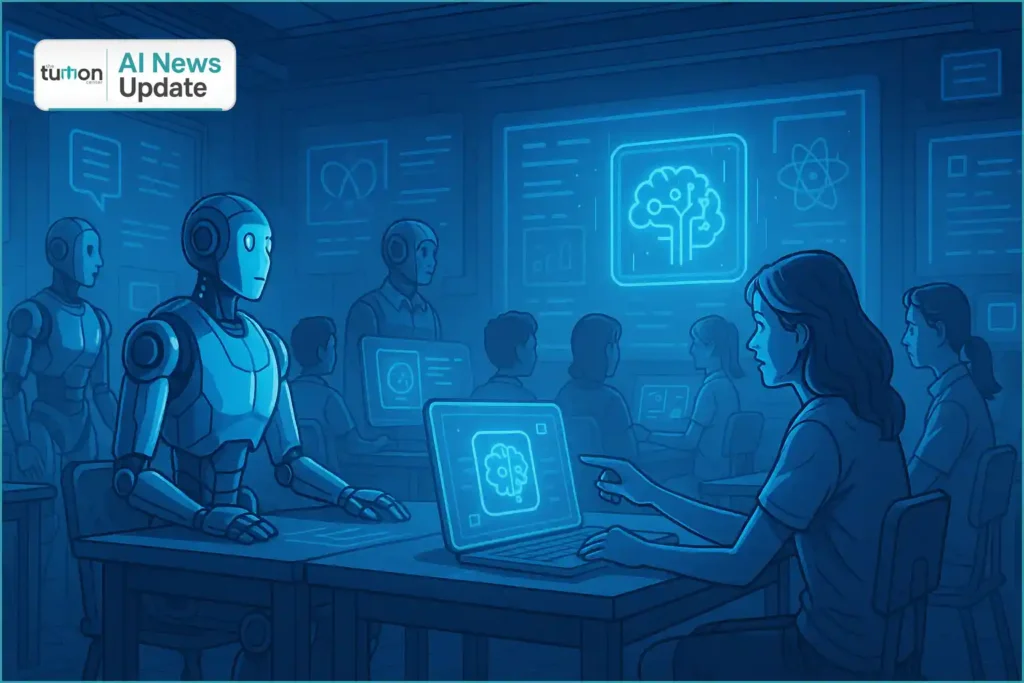
AI personal tutors have moved from experimental prototypes to mainstream global education tools — offering personalized, multilingual, 24×7 support to students in every corner of the world.
- Over 1.5 billion students worldwide now interact with AI-powered learning tools.
- AI tutors offer personalized learning paths, instant feedback, and multilingual explanations.
- Governments are incorporating AI tutoring into public education infrastructure.
Introduction
For decades, education experts have known that personalized tutoring is the most effective learning method. But one-to-one tutoring was expensive, inaccessible, and limited to privileged students. That barrier collapsed in 2024–2025 as Generative AI matured into intelligent, multilingual personal tutors available on every device.
These AI-powered tutors are patient, adaptive, and always available. They explain concepts at the student’s pace, correct mistakes gently, generate unlimited examples, translate lessons instantly, and offer personalized practice material. This marks the start of a new era — an age where every learner has their own private teacher.
Key Developments
1. AI Tutors Become Multimodal
AI can now teach using video, audio, animated diagrams, step-by-step visualizations, interactive quizzes, and real-time conversation. Students learn using whichever format suits them best.
2. Local Language Support Expands
AI tutors support more than 130 languages — including Hindi, Tamil, Telugu, Bengali, Marathi, Gujarati, Arabic, Swahili, Thai, Japanese, Korean, French, Spanish, and many more. This eliminates language barriers that once held millions back.
3. Personalized Learning Paths
AI identifies each learner’s strengths and weaknesses, then builds individualized lesson plans. It knows when a student is confused, when to slow down, when to give hints, and when to challenge them.
4. Homework & Exam Assistance
Students get help with assignments, mock questions, exam strategy, doubt clearing, and topic revision. But AI systems also ensure that they teach — not just give answers.
5. AI Tutors for Special Needs
Students with ADHD, dyslexia, autism, or sensory challenges are benefiting from adaptive learning modes — including slow speech, simplified text, structured visuals, and role-play instructions.
6. AI Tutors Integrated Into Classrooms
Teachers use AI to create lesson plans, generate worksheets, track progress, and deliver personalized support to every student. AI becomes a co-teacher rather than a replacement.
Impact on Students, Teachers, and Parents
Students: Learning becomes more engaging, less stressful, and deeply individualized. Students who previously struggled with concepts now gain confidence through step-by-step AI guidance.
Teachers: AI clears repetitive tasks like grading, question generation, and activity design. Teachers get more time for mentoring, creative instruction, and emotional support.
Parents: AI tutors keep parents informed with progress reports, learning recommendations, mistake analysis, and personalized home study plans.
Why AI Tutors Are So Effective
The power of AI tutoring comes from its ability to “know” the learner. It analyzes mistakes, learning behaviors, timing patterns, emotional responses, and topic mastery. For every concept, AI offers:
- Easy explanations
- Advanced explanations
- Examples in the student’s own interests
- Interactive practice
- Real-time corrections
- Revision prompts
This creates a level of personalization that is impossible for human teachers in large classrooms.
Expert Insights
“Personal tutoring has always been the gold standard. AI finally makes it accessible to every child on the planet.”
“AI tutors don’t replace teachers — they multiply their impact.”
“Within 5 years, AI tutoring will become a global education right, not a luxury.”
India & Global Angle
India is leading the world in AI tutoring adoption. With over 260 million students, the demand for personalized learning is massive. Platforms from Bengaluru, Hyderabad, Pune, and NCR are creating world-class AI tutors for Indian and global markets.
The government’s IndiaAI Mission, DIKSHA evolution, and NEP 2020 acceleration have pushed AI into classrooms from grade 1 onwards.
Globally, the U.S., Singapore, UAE, China, Canada, and South Korea are integrating AI tutors at a national scale. African nations use AI to solve teacher shortages. Europe focuses on safe and ethical AI tutoring frameworks.
Policy, Research, and Governance
Governments must ensure that AI-powered learning is safe, ethical, and equitable. Key policy areas include:
- Data privacy and child protection
- Transparent AI explanations
- Bias-free learning recommendations
- Monitoring of AI-teacher interactions
- AI safety certifications for EdTech platforms
- Teacher training for AI-assisted classrooms
Challenges & Ethical Concerns
- Risk of over-reliance on AI-generated answers
- Variation in model accuracy across subjects
- Uneven access to devices and internet
- AI hallucinations in rare academic topics
- Need for continuous teacher oversight
Future Outlook (2025–2030)
- Every student will have a personal AI tutor from primary school.
- AI will track skill development from childhood to adulthood.
- AI-based learning portfolios will replace many traditional report cards.
- Schools will use AI to detect learning gaps instantly.
- AI tutors will support competitive exam prep at massive scale.
Conclusion
The future of learning is personalized. AI tutors are not replacing teachers — they are amplifying their reach, empowering students, and transforming homes into intelligent classrooms. For millions of learners worldwide, AI is becoming the most patient, accessible, and effective teacher they’ve ever had. The next generation will not just learn from AI; they will learn how to create, evaluate, and collaborate with it — shaping a smarter, more confident global society.