
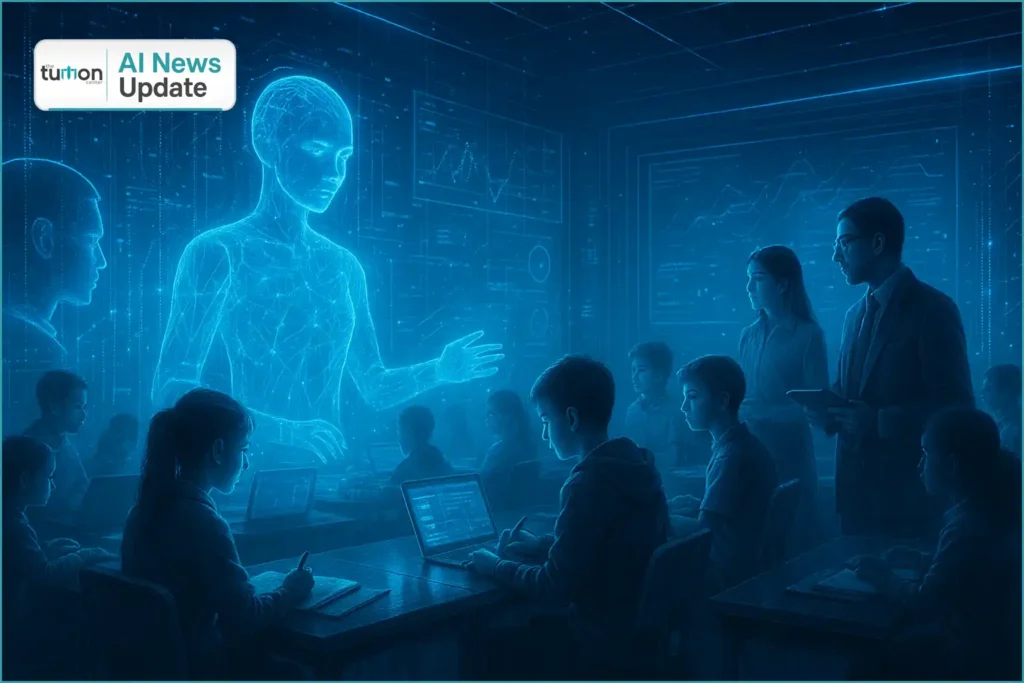
From adaptive cognition to emotional intelligence, the next generation of AI in education is transforming how humanity learns — one student, one moment, one data point at a time.
- Researchers at Stanford, IIT-Madras, and Google DeepMind unveiled emotion-adaptive learning agents in 2025 capable of analyzing facial expression, tone, and attention span to adjust content difficulty instantly.
- UNESCO’s “AI for Education 2030” roadmap calls emotional-aware AI “the next leap in human-centered learning,” projected to close learning gaps for 250 million children.
- From rural India to Silicon Valley, classrooms are entering an era where empathy meets algorithms.
Introduction: When AI Learned to Listen
For years, AI in education meant automated grading, chatbots, and predictive analytics. But in 2025, a new generation of learning systems began to perceive something subtler — the *human state of mind.* Cameras that track micro-expressions, microphones that interpret hesitation, and gaze-tracking models that read engagement now feed adaptive learning engines that tune content in milliseconds.
It is a quiet revolution. These AI tutors are not replacing teachers; they are amplifying empathy. They help educators understand *why* a child struggles, not just *where.* For the first time in digital learning history, machines are beginning to sense the emotions that shape learning itself.
The Science Behind Emotion-Aware AI
At the heart of this transformation lies a fusion of neuroscience and machine learning known as affective computing. Coined by MIT’s Rosalind Picard in the 1990s, affective computing explores how systems can detect, interpret, and respond to human emotion. Until recently, progress was limited by data scarcity and privacy barriers. But the arrival of multimodal models — those that combine text, vision, and audio — has changed everything.
In 2025, the Stanford-IIT-Madras “Project Anubhav” unveiled an AI framework trained on culturally diverse student data across India, Africa, and Europe. The model can identify over 120 learning-related affective cues — from boredom to curiosity — with 91% accuracy, adapting lesson pace and tone dynamically. Google DeepMind’s concurrent “Learning Compass” initiative uses similar multimodal sensing to predict frustration thresholds and recommend micro-breaks before burnout occurs.
From Adaptive to Empathetic Learning
Traditional adaptive platforms adjust content based on performance; empathetic systems adjust based on *emotion.* If a learner shows signs of confusion, the AI slows down, revises explanations, and offers hints. If enthusiasm peaks, it accelerates, introducing enrichment problems or creative challenges. This mirrors the intuition of great human teachers — now at scale.
UNESCO’s 2025 pilot across Kenya, Finland, and India found a 30% increase in comprehension scores when AI tutors integrated emotion recognition compared with static adaptive systems. Teachers reported higher engagement and less test anxiety among students who felt “understood” by the digital companion.
Human Teachers: From Lecturers to Learning Architects
Contrary to fears of replacement, AI is redefining teachers as *learning architects.* With emotion analytics dashboards, educators can visualize class energy, attention zones, and stress hotspots. Instead of spending hours marking papers, they can invest time mentoring creativity, ethics, and collaboration. AI handles measurement; humans handle meaning.
In Bengaluru, the EdTech startup LearnSphere collaborates with government schools to deploy “AI Co-Teachers” that track each student’s learning curve. Teachers receive daily summaries highlighting students who need emotional support, not just academic help. “It’s like having 30 assistants quietly observing empathy,” says founder Neha Kashyap.
Case Study 1: India’s National AI Classroom Pilot
In 2025, India’s Ministry of Education launched the “National AI Classroom” initiative under the IndiaAI Mission. Partnering with Bhashini for multilingual translation, the platform enables emotion-aware lessons in 22 languages. The system recognizes regional nuances — a student in Tamil Nadu receiving feedback in Tamil intonation differs from one in Punjab. Early results show 25% higher retention and 40% lower dropout among rural learners.
Case Study 2: Finland’s Human-AI Schools
Finland’s EduLab collaborated with NVIDIA Research to create a “Human-AI School” model where AI agents co-teach alongside educators. Each class begins with a “sentiment check,” using facial and voice data (processed locally for privacy) to assess readiness. Teachers then adjust activities accordingly. Parents receive weekly AI-generated reports summarizing emotional well-being, not just grades.
Case Study 3: UNESCO’s Global AI Tutor Network
UNESCO’s AI for Education 2030 project launched the world’s first open global AI tutor network in 2025. Built on open-source architectures from Meta (LLaMA) and OpenAI, the system supports 45 languages, integrates emotional cues, and functions offline for low-connectivity regions. Early deployments in Sub-Saharan Africa increased literacy rates by 18% within 18 months. The network also trains local developers, ensuring cultural alignment.
The Ethics of Sensing Emotion
As emotion-AI enters classrooms, concerns about privacy and consent intensify. Should cameras watch every frown? Can emotional data be stored responsibly? UNESCO’s Ethics Office stresses the need for “digital dignity charters” in education: informed consent, anonymized processing, and opt-out rights. India’s Digital India Act 2025 already mandates that emotion-sensing features must run locally, not in the cloud, to prevent misuse.
Transparency builds trust. Schools adopting AI should disclose what is measured, why, and how it benefits learners. When empathy becomes data, ethics becomes pedagogy.
AI Literacy 2.0: Teaching Students to Learn with AI
The new research frontier is not teaching AI to teach humans, but teaching humans to learn with AI. Curricula worldwide now include “AI Literacy 2.0” — covering prompt design, critical evaluation, and emotional intelligence in digital spaces. UNESCO and OECD recommend introducing these skills by middle school.
At The Tuition Center, this vision aligns directly with our mission: helping students not only understand algorithms but also cultivate self-awareness when guided by them. The AI-enhanced learner is part scientist, part philosopher.
Global Market Outlook for AI in Education
According to HolonIQ’s 2025 EdTech Market Report:
- AI-driven education market value: $40 billion (2025), projected to exceed $90 billion by 2030.
- Top growth sectors: adaptive tutoring, emotional analytics, teacher-assist dashboards, and accessibility tools.
- Asia leads adoption with 38% market share; India alone accounts for $5.5 billion in EdTech exports.
Investors call emotion-aware AI the “next billion-student opportunity.” Yet, the real impact lies beyond numbers — in creating classrooms that recognize humanity as deeply as they transmit knowledge.
Teacher Training and Reskilling
To unlock AI’s potential, teachers need training in both ethics and operation. UNESCO’s TeacherAI 2025 program offers micro-credentials in AI-pedagogy, data privacy, and emotional analytics. In India, CBSE’s AI Competency Framework integrates emotional intelligence modules alongside technical proficiency. The result: teachers who can interpret AI insights without surrendering intuition.
The Cognitive Frontier: Brain–AI Interfaces in Learning
Beyond emotion, researchers are exploring neural feedback. In 2025, the University of Tokyo and MIT Media Lab demonstrated a non-invasive brain-AI interface that adjusts lesson complexity based on real-time EEG data. If focus wanes, the lesson pauses; if engagement peaks, it deepens. Ethical debates are fierce, but the concept hints at future classrooms where cognition itself becomes a feedback loop.
Bridging Inequality: AI for Inclusive Learning
Emotion-aware AI also opens doors for learners with disabilities. Speech-emotion models enable personalized assistance for neurodiverse students. Visual AI converts text to sign language animations in real time. UNESCO’s 2025 report calls inclusion “AI’s most moral use case.”
In rural Odisha, for example, a solar-powered AI hub now delivers bilingual lessons through offline avatars that recognize learner engagement via micro-gestures, improving female literacy by 20% within a year.
Psychological and Social Implications
As learners bond with AI companions, psychologists warn against over-reliance. Children may anthropomorphize their digital tutors, forming pseudo-emotional attachments. The solution is guided co-presence: teachers and parents must remain the emotional anchors while AI handles personalization. Hybrid empathy — shared between humans and machines — is the goal.
Future Outlook (3–5 Years)
- AI tutors will integrate biometric and emotional signals to personalize not just *what* students learn, but *how* they feel while learning.
- Teacher dashboards will evolve into emotional-intelligence consoles, helping educators anticipate burnout and motivation cycles.
- AI literacy will merge with social-emotional learning (SEL) — empathy, resilience, and ethics taught alongside coding and math.
- Data-sovereign AI systems will ensure local processing to protect privacy while maintaining personalization.
- By 2030, “AI-inclusive schools” will be a UNESCO benchmark — defining equity, accessibility, and emotional safety as success metrics.
Conclusion: The Human Heart of Intelligence
The most profound innovation of 2025 is not a faster model — it is a kinder one. AI is learning to listen, to perceive emotion, to adapt with care. Education is becoming not just personalized, but humanized. The next frontier of AI is empathy at scale — technology that understands, not just instructs.
For students, teachers, and policy-makers, this is a call to action: ensure that algorithms amplify compassion, not control. Let AI be the mirror that reflects our best instincts — curiosity, patience, understanding. Because the future of learning will not be man versus machine; it will be mind and heart together, learning as one.
“`