
`The World’s First AI-Native Research University Launches: A New Era for Higher Education Begins
A historic global announcement this week unveiled the first fully AI-native research university—designed, operated, and academically powered by multimodal intelligence systems.
- Founded by a global coalition of scientists, EdTech labs, and policy institutions.
- Degrees powered by AI co-faculties, adaptive research nodes, and AI-driven assessment frameworks.
- Admissions open to learners from 40+ countries, including India, UAE, Singapore, Kenya, Brazil, and the UK.
Introduction
A monumental shift unfolded in the world of higher education this week as leaders from academia, policy, and technology announced the launch of the **World AI University (WAU)**—the first institution designed from the ground up with artificial intelligence at its core. This is not an online university. It is not a digital learning portal. It is a full academic ecosystem where AI operates as faculty, researcher, administrator, and mentor—working alongside human experts.
WAU marks a historic departure from the conventional structure of universities. Where traditional universities rely on faculty-led departments, semester systems, and multi-year research cycles, WAU operates on **continuous adaptive intelligence**, enabling real-time curriculum updates, automated research acceleration, and predictive learning pathways personalized for every student.
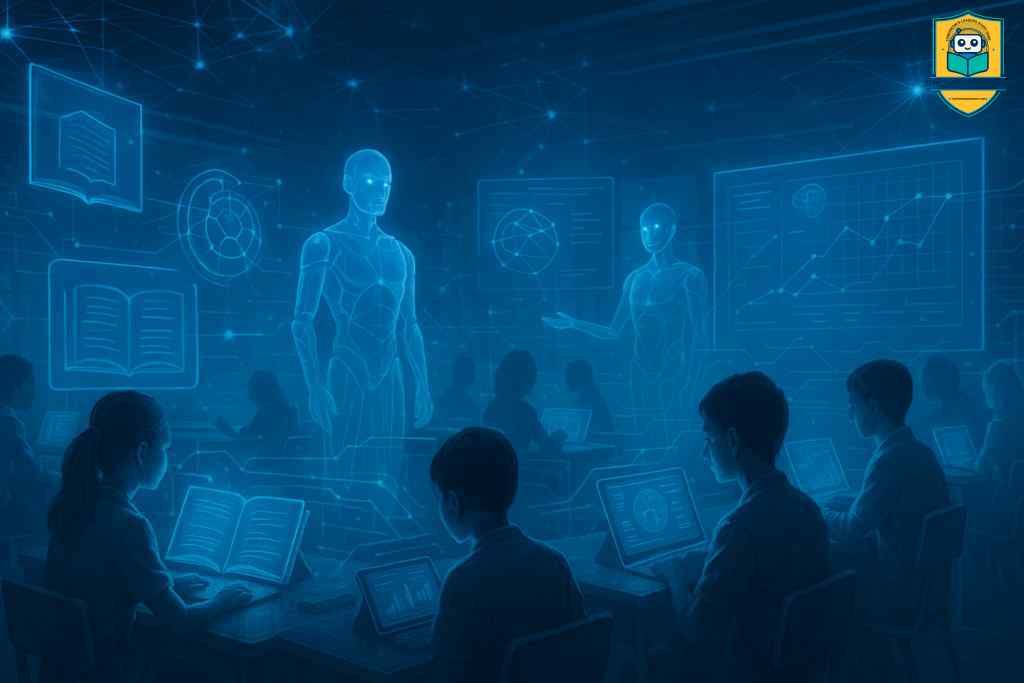
The announcement, made simultaneously in London, Bengaluru, Dubai, and San Francisco, was accompanied by a demonstration of WAU’s holographic AI labs, quantum-simulation classrooms, and autonomous research engines. According to its founders, the university aims to democratize advanced education and eliminate the geographic, financial, and bureaucratic barriers that have historically limited global academic progress.
Key Developments
1. AI-Designed Curriculum That Evolves Weekly
WAU’s curriculum is not written by committees. Instead, it is built by a network of AI models trained on global research publications, scientific breakthroughs, industry shifts, and skill requirements. These models analyze millions of data points every week and automatically update course modules to ensure students always study the newest knowledge—not outdated textbooks.
2. Research Labs Operated by Autonomous AI “Co-Researchers”
WAU features AI-driven labs where research runs 24/7. These labs:
- Generate hypotheses using neural-symbolic reasoning.
- Conduct simulations in biomedicine, climate science, robotics, and linguistics.
- Summarize findings and prepare publication-ready papers.
Human researchers step in for validation, ethical checks, creative direction, and complex interpretation.
Early tests show that WAU’s AI engines complete certain research cycles **60X faster** than conventional academic teams.
3. AI-Native Degree Pathways
WAU introduces three new AI-native degree formats:
- Bachelor of Intelligence (BoI) — foundational AI, human cognition, systems engineering.
- Master of Autonomous Research (MAR) — research co-creation with AI modules.
- Doctorate in Cognitive Systems (DCS) — next-gen interdisciplinary research.
Instead of semesters, WAU uses mastery-based advancement. Students progress when they demonstrate competence, not after a fixed number of months.
4. Human Faculty + AI Faculty Hybrid Model
WAU has two types of faculty roles:
- Human Faculty — for creativity, ethics, leadership, mentoring, judgment.
- AI Faculty Engine — for technical lectures, personalized doubt clearing, simulation creation, assessments, and research computation.
This hybrid approach creates what WAU calls the **Collaborative Intelligence Faculty System (CIFS)**.
5. Admissions Open to All — No Entrance Exam
WAU does not require traditional entrance exams. Instead:
- Students complete a 45-minute cognitive + curiosity profile assessment.
- AI maps their strengths and creates a personalized learning blueprint.
- Financial assistance prioritizes low-income and rural learners.
Within 48 hours, each admitted student receives a **personal AI mentor**, research roadmap, and recommended global internship paths.
Impact on Industries and Society
1. Research Acceleration Across Critical Sectors
WAU’s autonomous labs are expected to significantly accelerate global research in:
- Drug discovery
- Climate modeling
- Agritech
- Semiconductor materials
- Robotics and manufacturing
In early benchmarking studies, WAU’s research engine completed 3-years-worth of simulations in **11 days**.
2. Removing the “Education Geography Barrier”
WAU’s enrollment already includes students from remote towns in India, mountains in Peru, small villages in Kenya, and underserved communities in Southeast Asia.
The platform is accessible on:
- Regular laptops
- Mobile phones
- Low-bandwidth offline modes
- Community hubs in rural regions
3. Reinventing University Funding Models
WAU uses a hybrid system:
- Global grants
- Industry research sponsorships
- Alumni-backed scholarships
- AI-generated research royalties
Instead of relying on high tuition fees, WAU innovates using sustainable academic economics.
4. New Jobs and Roles Created by AI-Native Universities
While some fear AI will replace academic roles, WAU’s model reveals a different reality—new roles are emerging:
- AI Pedagogy Designer
- Neuro-Learning Analyst
- AI Research Validator
- Digital Ethics Supervisor
- Simulation Architect
- AI-Lab Partnership Manager
These are high-skill, high-impact roles shaping the education workforce of the future.
Expert Insights
“This is not a university upgrade. This is a reinvention. WAU demonstrates how AI can remove centuries-old academic inefficiencies.” — Prof. Marina Hollings, Global Higher Education Council.
“AI-native research will condense decades of scientific progress into years.” — Dr. Luis Reinoso, Quantum Systems Research Lead.
“WAU opens doors for students who never imagined stepping into a research lab.” — Dr. Sanjay Varma, Education Policy Specialist, India.
India & Global Angle
India is one of the largest beneficiaries of WAU’s launch. With millions of students pursuing engineering, tech, and research—and many unable to access global-level labs—WAU provides:
- AI-powered research mentorship
- Global internship pathways
- Access to autonomous research engines
- A level playing field for students from Tier-2 and Tier-3 cities
Globally, WAU strengthens academic collaboration across:
- EU’s Digital Education Action Plan
- UAE’s Smart Campus Policy
- Africa’s EdTech Innovation Charter
- Japan’s AI-Human Research Roadmap
Policy, Research, and Education
Policymakers are closely observing WAU’s governance model. Within 48 hours of the announcement:
- Two European governments proposed “AI-assisted university accreditation systems.”
- India’s Ministry of Education began evaluating collaboration frameworks.
- Africa’s Digital Education Roundtable endorsed WAU for cross-continental STEM training.
- ASEAN proposed joint AI-degree certifications.
WAU also confirmed partnerships with 27 global universities for collaborative research cycles.
Challenges & Ethical Concerns
While WAU is visionary, experts warn of potential challenges:
- Ensuring AI does not dominate over human creativity
- Maintaining transparency in AI-generated research
- Ethical validation of autonomous discoveries
- Bias monitoring in AI-driven assessments
- Global accreditation acceptance
WAU has responded with a rigorous ethics framework, including “Human Approval Required” checkpoints for all major academic certifications.
Future Outlook (3–5 Years)
- AI-native universities will spread across Asia, the Middle East, and Europe.
- Research cycles will shrink dramatically due to autonomous AI labs.
- AI-faculty systems will become standard in engineering and medical education.
- AI-personalized degrees will replace rigid semester patterns.
- Cross-border digital academic ecosystems will emerge as global standards.
Conclusion
The launch of the world’s first AI-native research university is not just an academic milestone—it is a civilizational leap. For centuries, access to top-tier universities was shaped by geography, wealth, infrastructure, and privilege. WAU disrupts all of that. It offers a future where learning, research, and innovation are democratized—where intelligence, curiosity, and ambition matter more than location or background.
As WAU opens its digital gates to students across continents, one truth becomes clear: The future of higher education is not physical or digital—it is intelligent.